

Introduction
So The Dispatch has expressed a certain level of displeasure with me.
I acknowledge at the outset that this apologia for my activities might seem like I am trying to aim my answers in two different directions, but I also want to maintain that this is not my fault. This article about me was conflicted and could not make up its mind. Am I too tall or too short? Being charged with both presents me with a unique argumentative challenge, but I shall do my best.
But as many of my readers know, I am in good company.
“It looked not so much as if Christianity was bad enough to include any vices, but rather as if any stick was good enough to beat Christianity with.”
Chesterton, Orthodoxy
And they will also anticipate that my use of the above quote will bring on the charge that I am equating myself with Christianity. Ah, but no. The point of comparison was the “any stick” part.
The Central Contradiction
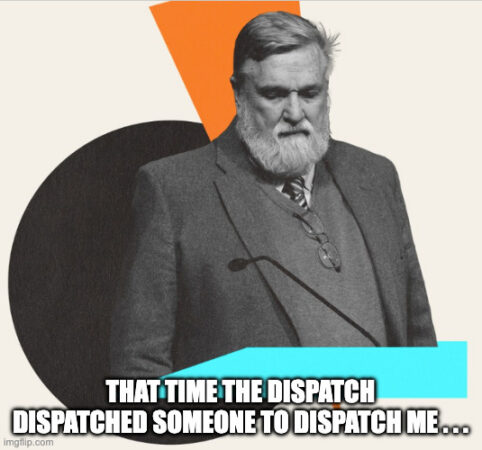
According to this piece, the central problem is that I am an abstract theoretician, playing around with various esoteric ideas while real people suffer. The other central problem is that I am a pragmatic hustler, building lots of stuff, and that I am not an abstract theoretician. When you put these central problems together, what you get is a pretty conflicted soul. I would feel genuinely sorry for such a person, pulled every which way like that, but fortunately, he doesn’t exist. He feels no pain.
Here’s me, up in the clouds, with all talk and no action:
“But this reliance on words also means that evangelicals are uniquely susceptible to the abuse of words. In a weird twist, evangelicals are more likely to follow the person who talks or writes about the importance of virtue than the person who is actually virtuous.”
Anderson and Reneau, The Great and Powerful Doug
“Similar questions apply to Wilson. How should we interpret the words of a man who operates in the theoretical?”
Anderson and Reneau, The Great and Powerful Doug
One more . . .
“For Wilson, [the digital age] means playing the theorist.”
Anderson and Reneau, The Great and Powerful Doug
But then, here’s the other me, not up in the clouds . . .
“Wilson himself is not lost in the clouds, however. He’s planted churches, built schools (including a college), started a publishing house, and founded a denomination. In this way, Wilson uses the power of abstraction for very practical ends.”
Anderson and Reneau, The Great and Powerful Doug
Okay, which is it?
Parrying a Flurry of Jabs
Michael Reneau said that I use “radical ideas to advance a not-so-unique, self-enriching playbook that looks much the same as big-time televangelists of yesteryear.” Self-enriching, eh? Just how rich am I? I would like to tell Nancy.
Hannah Anderson says that my daughters and wife bill themselves first as homemakers. Well, they don’t bill themselves as homemakers. They are homemakers. The fact that they have written all those books simply means that competent conservative women don’t fit into the preconceived box that Anderson had assigned for them to occupy.
“Wilson’s daughters, Rebekah and Rachel, and his wife, Nancy, play significant roles as public communicators of Wilson’s message, billing themselves first as homemakers.”
Anderson and Reneau, The Great and Powerful Doug
The article also rolled out a farrago of old charges filled with mistakes, half-truths, and creamy noodles.
“This same indifference explains how Wilson could guide a young woman who was a New St. Andrew’s student to marry a convicted pedophile who was a part of their church community . . .”
Anderson and Reneau, The Great and Powerful Doug
When people get into bad sin, which some of them do, and they create circles of devastation around them, faithful pastors serve as the ER doctors. You comfort the victims, correct and discipline the offenders, you counsel everyone, and labor to reset the bones as best you can. There is nothing whatever that is theoretical about any of it. The theoreticians are those who, decades later, get a hold of about a third of the facts, some of them wrong, and evaluate the situation from across the country.
On Not Acting Like a Demagogue
According to the article, my delivery of incendiary material is “decidedly unbothered.” This is indicative, per hypothesis, of just how thick the calluses must be on my tenderer sentiments. But of course I seek to remain steady, calm, objective, and detached. How else could I talk to these journalists?
“The emotional gap between Wilson’s rhetoric and how people respond to it is one of the defining features of his public presence. It’s also a key to understanding his ideas and how he uses them.”
Anderson and Reneau, The Great and Powerful Doug
Translated, this means that because I don’t lose my cool it follows that I don’t care. Being from the old school, I believe that a vile person is someone who says or does vile things. But in this cracked new order of ours, if I say something that is politically incorrect, and others explode into vile speech or action, and I do not respond in kind, this clearly means that I am the one with the problem. For just one example (among many), we planted a church service in DC a little over a year ago, and we have had protesters there on the regular, yelling obscenities at the folks going in to worship. And we are the problem because we don’t do that kind of thing in return. We are worshiping in such a way as to make some protester show up in order to wave a dildo at our parishioners, and so we must be really problematic. But we conduct ourselves the way we do because certain authorities who outrank the Dispatch told us to conduct ourselves in this way (Prov. 15:1; 1 Pet. 2:23; 1 Pet. 3:9; 1 Cor. 4:12-13; Jas. 1:19-20; Matt. 5:44).
“Wilson’s demeanor, even if slightly awkward, was not forceful or aggressive. He was measured, friendly, playful. But that disconnect—between the weight of what Wilson is suggesting and how easily he suggests it—is what’s concerning.”
Anderson and Reneau, The Great and Powerful Doug
In sum, Wilson’s problem is that he was nice, polite, and friendly, and holds views that the people in the Dispatch cocoon have deemed beyond the pale. And he just said them, you know? Out loud and everything.
“In this way, Wilson can be deeply disorienting. The true ideologue speaks with wholeness—the totality of their words, demeanor, and actions all say the same thing. Completely given to their ideas and the promotion of them, their personal presence and posture reflect this unity, even if that means coming across as a little unhinged. But Wilson seems able to emotionally disconnect himself from many of his ideas as well as from other disturbing realities. In the NPR interview, Wilson discussed atrocities like rape and genocide as if they existed only in theory.”
Anderson and Reneau, The Great and Powerful Doug
In other words, my sentiments are those of a nutjob, but I don’t come across like a nutjob, and this causes cognitive dissonance in the ranks of those who desperately need me to be a nutjob. Because once they admit that I might not be, they are in the perilous state of being on the edge of a discussion.
“He sits for an interview because “all press is good press,” as the saying goes. He gets a hearing, and regardless of whether you subscribe to his ideas or get lost trying to debate them, he wins. You get bogged down while he continues doing what he’s doing.”
Anderson and Reneau, The Great and Powerful Doug
No. I will tell you why I sit for these interviews. I am not trying to bog people down in the twists and turns of debate. I simply want to confront them with the reality that there is obviously way more to the stories they have been told about us. There is. A lot more. And I can communicate that reality simply by showing up clothed and in my right mind. A pretty low bar, but there it is. A lot of NPR viewers tuned in expecting to see a man with three heads, and with two of them drooling. All I needed to do to mess with a bunch of people’s categories is just leave two of my heads at home—the ones that drool, obviously.
Previous Slanders
In the NPR interview, I told Fadel that over the last several years there had been a marked improvement in how we were being treated. Prior to that, it was mostly the high mountain of public calumny. Our critics were for the most part simply unhinged, and threw at us whatever they could.
“Speaking with Fadel, Wilson suggested that previous interviewers just threw ‘mud at the wall. You’re a fascist. You’re a Nazi. You’re a thing, you know . . .’ but now, he’s ‘risen to the dignity of needing to be intelligently opposed.’
Anderson and Reneau, The Great and Powerful Doug
I was saying this to Fadel (and I was including her) as a genuine compliment. I really had noticed a number of journalists interviewing me recently who had come prepared, who knew what I had written on the subject, and who already knew the details of my anticipated responses. In short, I was commending a number of the people covering us now, even when they were critical or adversarial. I was praising the intelligent coverage.
Alas, this piece in The Dispatch represents something of a relapse.
“Wilson noted that in the last five years, his ideas have been getting ‘a much more significant hearing than we ever have before, where people are actually listening to what we say.’ It’s a stretch to think that this is the natural outworking of the superiority of Wilson’s political vision. any more than to believe that Trump’s business acumen landed him the presidency. But Wilson, like Trump, is particularly suited to this moment.”
Anderson and Reneau, The Great and Powerful Doug
In that part of the discussion, I did not attribute my suitability to the moment to the superiority of my vision. I said that it was the result of the decided and manifest inferiority of the older establishment vision. Liberal secularism has got the staggers. They don’t even know what a girl is. Over the course of the last 4-5 years, one establishment institution after another has profoundly disgraced and discredited themselves. So when all the respected insiders step on a rake, it is just a matter of time before the normies and grillers start considering what the outsiders might have to say.
The Empathy Pit
Given that the hot take on me was that my approach is emotionally detached, it was inevitable that the empathy thing would come up.
“This ability to remain undisturbed while discussing deeply disturbing things is both a practiced posture and a necessary one. Over the last eight years, Wilson has been a main promoter of the idea of ‘the sin of empathy’ within theologically conservative spaces. As before, the idea is not original to Wilson, but Moscow has been effective in pushing the conversation forward as a paradigm that can be used to justify increasingly extreme policies of the hard right, including President Trump’s mass deportation campaign.”
Anderson and Reneau, The Great and Powerful Doug
To review our actual position, compassion is not a sin. Sympathy is not a sin. Tenderness and kindness are not sins. Neither is gentleness. Check out all of that here and here. Nor is it a sin to feel bad sympathy for journalists and to refrain from yelling at them.

The Pink Spiders of Empathy
Although I was not the instigator of the empathy wars, not me, I was there when things started heating up, and so I have been a close observer of the whole thing, and a sometime contributor. As you will see in this collection of observations, the pilot program for Man Rampant consisted of a conversation I had with Joe Rigney on the subject, related to work he had done with the issue. T…
But empathy is a sin when it detaches entirely from the objective realities of the situation. And the reaction that this simple point has received serves to illustrate how deep into the sin we have gotten.
“As the argument goes, empathy is disordered insofar as it asks you to experience the feelings of another person or put yourself in their shoes. Instead, the morally and intellectually superior person is the one who is able to remain detached. You can grieve with them, but it must be a theoretical grief in the sense that the grief does not affect your supposed objectivity.”
Anderson and Reneau, The Great and Powerful Doug
No. That is not how the argument goes. Let me fix that sentence for them. “As the argument goes, empathy is disordered insofar as it asks you to experience the feelings of another person or put yourself in their shoes to such an extent that truth and falsehood don’t matter to you anymore. ” The grief you feel in true compassion is not “theoretical” at all. We are to weep with those who weep—but godly tears don’t erase a commitment to the truth.
“Wilson’s ability to separate the theoretical and actual also explains how he could devote his first book to a philosophical exploration of American slavery, writing that it was a ‘normal sinful situation’ rather than an ‘apocalyptic evil.’ The cover image is of a ‘black and tan,’ a mixed drink made by pouring a darker beer over a lighter one.”
Anderson and Reneau, The Great and Powerful Doug
First, that book was nowhere close to being my first book. That’s a small detail, but indicative of larger issues.
The other point, far more substantive, is that this book is described as an example of me separating theory and practice when it was actually an example of trying to unite them. You want to work through what you think about certain situations so that when you get into such a situation you know what you should do. In theological terms, orthodoxy and orthopraxy are always supposed to go together. You should study what the Bible says so that you know what you should do when you find yourself in a situation where some sort of action is required. Life comes at you fast. Work out what you think beforehand so that what you believe and what you do are an organic unit.
Engage the Actual
Those of you who have been reading the blog for a while probably know what is coming next . . .
“So what are we to do with men like Doug Wilson and his use of “radical ideas”? . . . So, it seems to me, the wisest response to someone like Wilson—whose wizardry depends on the smokescreen of the theoretical—is to engage the actual.”
Anderson and Reneau, The Great and Powerful Doug
A great idea. Let’s engage the actual. So I would like to take this opportunity to invite Hannah Anderson to write a follow-up piece . . . after she visits us here. We will pay for her travel and accommodations, and will give her a tour of all the actual things. On the flight out, she might feel like she was on assignment to write an article about some exotic zoo exhibit. I don’t think she would feel the same way on the flight home.
“Wilson is not dangerous because he is an ideologue. He is dangerous because he’s comfortable entertaining radical ideas to further pragmatic ends, knowing that if they go wrong, he can always retreat to the safety of the theoretical.”
Anderson and Reneau, The Great and Powerful Doug
This is a fallen world, and things can always go wrong. But were that to happen, whatever it was, I would take refuge in the God of all comfort, in the promises of Scripture, and in the community of saints who are living out their faith in very practical and tangible ways. There would be nothing theoretical about any of it, thank God.