

Introduction
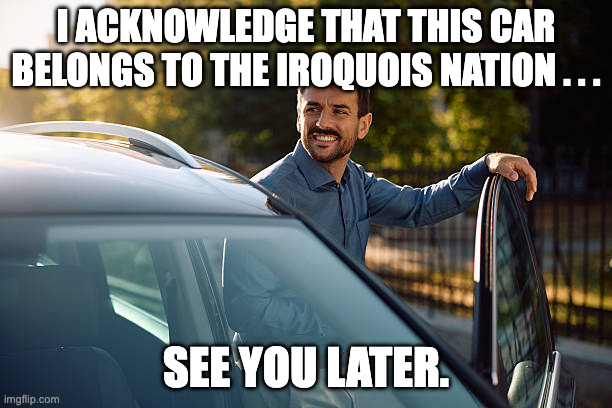
So let us talk about that impotent contemporary ritual called the “land acknowledgment.” Nowadays when an event or activity is going to be taking place somewhere, or an institution is opening, the proceedings will often begin with a land acknowledgment. This is a little empty gesture recognizing the indigenous people who used to live there. Along with the implication that nothing will be done about it.
For example, the recent opening of the Obama library in Chicago, that architectural freakshow, began with a land acknowledgment. There was a veritable festival of tribes involved. First came the Ojibwe, Odawa, Potawatomi nations. Also rans included the “Myaamia, Ho-Chunk, Menominee, Sac and Fox, Peoria, Kaskaskia, Wea, Kickapoo, and Mascouten.”
Now of course such hat-tip land acknowledgments make no practical difference whatever to these indigenous peoples, who are still as displaced as they ever were, but it does help individuals who have that itch of white self-loathing to scratch that itch, and in public too.
Some Practical Problems
The first big problem with land acknowledgments is the practical one. Pretty much nobody is living where they should have been living had everybody behaved as they ought to have done—where would we all be living had there been no sin in the world? Not an easy question to answer.
The history of the world is a history of invasions, migrations, displacements, conquests, population collapses, broken treaties, and more. This means that for any given land acknowledgment, you have to pick an arbitrary date as you decide to honor prior occupants. If you were to pick the years 1800, 1600, or 1100, you would in many cases find yourself acknowledging very different groups. You might even drill down to the victims of the thieves you were acknowledging—as the first nations were often the first thieves.
Do we have anyone proficient enough in math to do a land acknowledgment for Crimea? All the way back?
And then there is the question of ethical adjudication. Sometimes the displacement was a tale of treachery and woe, and other times the earlier occupants got what they deserved, good and hard. It is hard not to sympathize with the Nez Perce, for example, and hard not to think something like good riddance when it comes to the brutal Comanche. Conquered is not necessarily a synonym for stolen.
That leads to a third practical issue, which is our refusal to see peoples grouped as tribal entities, as ethnic nations, as opposed to the common and very lazy device of grouping everybody by skin tint. In the days of apartheid in South Africa, it was easy for the world think of the problem as simply “white” and “black.” But there were three major black tribes (Zulu, Xhosa, and Sotho), and two major white ones (Dutch and English). Not only that, but the Dutch were very early settlers there. Should contemporary land acknowledgments in South Africa (not that they would ever have them) include the Dutch?
To be sure, white federal troops displaced the Sioux in the Great Plains area, but then again, the Sioux had displaced the Cheyenne (among others). And the Sioux had come west from the Great Lakes region because of their conflicts with the Ojibwe. The Ojibwe, you recall, were intent on sticking around so that they could eventually receive their land acknowledgment from the Obama Library and Architectural Tumor. And the white federal troops that subdued the Sioux were the same troops that had just finished subduing the white tribe of the Confederacy. Maybe skin color isn’t the most helpful metric.
For some reason, all this nonsense reminds me of the debate that was raging in the late nineties before we turned the Panama Canal over to Panama. There was much indignation over the fact that the Americans had just waltzed in there, and done our thing. And so, the reasoning went, we ought to return the canal to Panama. But, as I argued at the time, we didn’t steal the canal from Panama. We stole it from Colombia. Why were we returning it to the people who helped us steal it? Panama declared independence from Colombia on Nov. 3, 1903. We recognized the new republic three days later. Twelve days after that, we signed a treaty with Panama giving us perpetual control of the Canal Zone. The treaty was just sitting there, all ready to go, which was quite the coincidence. So why didn’t we return the canal, along with Panama, to Colombia?
My point here is that the history of land occupation is very complicated, such that when people start conducting little rituals such as these land acknowledgments, the reason for it is not to put anything right with a wronged tribe, but rather to perpetrate additional wrongs in the here and now. These acknowledgments are being done for contemporary political purposes, all of them unsavory. Driven by the self-loathing mentioned earlier, they are simply attempts to undermine public trust in the current order. In short, it is revolutionary propaganda of the same sort that pulled all the statues down a few years ago. They are not trying to get the Chicago area back to the Ojibwe, but are rather trying to keep it under the control of the commies.
How Israel Happened
We have the same kind of complexity when it comes to the formation of the modern state of Israel. As we work through this, remember that the topic is land acknowledgments, not Zionism. I say this because whenever I mention Israel I get accused of being a Zionist shill by a tribe of people who don’t know what Zionism is. I merely state this by the way.
Bear with me for a minute while I get a few things out on the table. One of them is the fact that one of the Gentile fathers of modern Israel was a man named Winston Churchill. The First World War ran from 1914 to 1919. The Balfour Declaration was given during the war in a 1917 letter from Lord Balfour to Lord Rothschild, a leader among British Jews, in which support for a national home for the Jewish people in Palestine was clearly expressed. The Ottoman Turks had entered the war on the side of the Central Powers, and they were the ones who had been in control of the region of Palestine. They therefore became wartime enemies to Great Britain. During the war, Britain negotiated separate deals with the Arabs (1915) and with the Jews (1917). In other words, “Help us in our fight against the Ottomans, and in exchange we will give you territory after the war.” After the Allies won the war, they were in possession of the Middle East, by right of conquest. They had won the war. Winston Churchill was a key figure in making sure that Britain kept its word to the Jews. Laurence of Arabia was a key figure doing the same for the Arabs. Churchill played a big role in getting Iraq and Jordan carved out for the Arabs. Now the Arabs had been promised specific areas, and the Jews were not guaranteed anything specific, just a homeland. But if the Jordan River divided Arabs to the east and Jews to the west, all the terms of the wartime commitments would have been fulfilled—for both Arabs and Jews.
But it was still dicey getting there. Britain had guaranteed a homeland for Jews from anywhere in the world, and it was up to Winston (more or less) to work with others on the rate of Jewish immigration. The challenge, as with all forms of immigration, was assimilation. In 1922, there was 80,000 Jews in Palestine and half a million Arabs. By 1936, the Jews numbered over 380,000, with the Arab population having grown significantly as well, to over a million and a quarter. Not only so, but many Arabs had come there because of the increasing prosperity that had come about through the Jews.
At the same time, there were periodic attacks on the Jews from the Arabs, and consequently there was hot political pressure back in Britain to renege on their commitment to the Jews. This is why there were eventually violent clashes between some Jewish groups and the British.
Now if you object to all these Zionist Jews making their way to Palestine, just pretend that they are the Ojibwe, making their way to the Obama library and tire center.
After Independence
After the Second World War, Britain said something along the lines of “deal me out.” The UN declared a two-state solution, which Israel agreed to, and Israel was formed as a legit nation in 1948. But immediately after Israel was formed, they were attacked from all sides—by Egypt, Transjordan, Syria, Lebanon, Iraq, Saudi Arabia, Yemen, and the Arab Liberation Army. Remarkably, they survived the assault. They lost some territory and gained some territory, but they hung on.
Another war erupted in 1967, when Israel was attacked again. Nassar of Egypt had evicted the UN peacekeepers from the Sinai Peninsula, and massed his troops there. There was a pan-Arabic movement that wanted to unite Syria, Iraq, and Jordan into a single state. These three countries had all been created by the Allies after World War 1. But there was still the difficulty of who would be in charge of this single state, and so they would vie for leadership by means of showing how hostile to Israel they all were. War exploded, and the thing lasted for 6 days. Israel, with a population of 2.5 million defeated a confederacy of nations with a population of over 100 million. As a result, Israel took the territories of the Sinai Peninsula, Gaza, the West Bank, Jerusalem, and the Golan Heights.
So it is not possible to argue, for example, that Israel’s possession of the West Bank is the cause of all the hostility. Rather, all that hostility was the cause of them conquering the West Bank. Israel also found herself governing about a million Arabs as a result of all this. If you think that is a problem, as I do, then perhaps the solution would be to urge the Arabs to stop starting wars that they then lose.
When you lose a war, you frequently lose territory, as in land. And that leads back to our problem of land acknowledgments.
If you are still struggling with this, just return to our thought experiment. Just imagine of the Jews to be the Ojibwe. Either ancestral lands are a thing or they are not. If they are not, then let us be done with all these land acknowledgments. If they are a thing, then let us drop our hostility to the only tribe that has successfully acted as though they are a thing. And for those itching to call me a Zionist shill at this point, drop it. The modern dogma of land acknowledgments has nothing to do with whether God promised Abraham that land, and I am just running a reductio on land acknowledgments. When Obama acknowledges the lands of the Ojibwe, no one calls him a devotee of their legendary Seven Fires Prophecy. You know, a Seven Fires Prophecy shill.
The Point Is Always Now
William Faulkner once had a character say, “The past is never dead. It’s not even past.” And Dabney once said to be sure the past was dead before you bury it. The thing to do in all current political discussions of people and territory is to realize that everything about such discussions is contemporary. There is always an agenda for now.
The appeal to the past, to history, is an attempt to get to some unquestioned axioms from which they can advance their current plan. The reason those axioms out of the past are unquestioned is because most people don’t know history, and they know they don’t know enough to say anything about it. That being the case, they feel they don’t know enough to oppose the “solutions” that will soon enough be brought forward by the commies.
The house where I live is built on land where the Nez Perce used to hunt. I know that much. And as mentioned earlier, I also believe the Nez Perce got a raw deal. But the reason I would never recite a land acknowledgement before I mow the lawn is because doing so would not redress any of the ancient wrongs, and it would contribute to the advancement of some new and very fresh wrongs.
Those who don’t learn from history are bound to repeat it. And those who do learn from history are bound to watch other people repeat it.