

Introduction
I would like to draw your attention to comments that were recently made by Neil Gorsuch, one of the more sensible members of our Supreme Court. And, as those comments should reveal, it is not always possible to be sensible all the time.
Here he is:
“The Declaration of Independence had three great ideas in it: that all of us are equal; that each of us has inalienable rights given to us by God, not government; and that we have the right to rule ourselves. Our nation is not founded on a religion. It’s not based on a common culture even, or heritage. It’s based on those ideas. We’re a creedal nation.”
Neil Gorsuch, in an interview with Nick Gillespie of Reason magazine
Okay, it is high time we chased this thing down. It is continuing to behave like a little greased piglet, but it must still be chased down. We shall not obtain the blue ribbon in any other way.
Contextualize This First
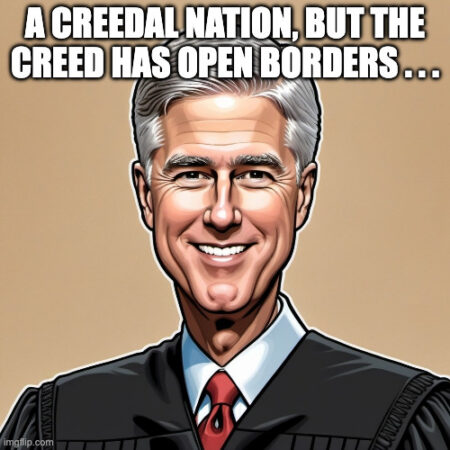
I have to begin by saying that I like Neil Gorsuch. I like the fact that he is on the Court. Despite a few unfortunate votes, his presence there is pretty reliable and steady. He voted to strike down Roe, and so he has won my friendship forever.
That said—and let us frank and honest here—that statement above is about as defensible as the infamous response of Ketanji Brown Jackson, which she made that time when the good senators decided for some reason to test her biology chops.
The fact that it is a widely shared sentiment, and widely shared among conservatives even, does not make it a whit more defensible. Jackson is not the only person who doesn’t know what a woman is, and Neil Gorsuch is not the only person who thinks that a nation is bound by a collection of etiolated propositions that nobody actually has to affirm.
Let’s take it apart for some analysis, shall we?
The Structure of the Claim
As part of the backdrop for our discussion, I would like to ask you to imagine three different church denominations, and then I will ask you to try to imagine something else regarding them.
First, I want you to imagine a denomination that holds to the 1646 Westminster Confession of Faith, but where fully two thirds of their pastors are New Age pantheists. Second, I would like for you to imagine a denomination that adopted the BCMW Danvers Statement into their standards 25 years ago, but with three quarters of their ministers now women, mostly lesbian. And now . . . work with me here . . . stay with me . . . I would like for you to imagine a convention of Baptists affirming every jot and tittle of the Baptist Faith and Message, while fully 55% of their churches allow for the practice of infant baptism. With me so far?
And so now here is the cash payout. Here is the hot question.
What would your reaction be if anybody from any one of these denominations solemnly tried to explain to you how important it was to their churches for their people to “remain confessional.”
This is why the kids of a previous generation came up with abbreviations like ROFL.
Gorsuch said that our nation is not based on a number of things, and that it was based on three other things. “It’s based on those ideas. We’re a creedal nation.”
Not common religion. Not common culture. Not common heritage. Rather, the foundation of our nation consisted of three propositions, all taken from the Declaration of Independence. Those three ideas were that 1. we are all equal; 2. our rights are given to us by God, not government; and 3. we have the right to govern ourselves.
It is hard to know where to start, so I will start at this closest end with #3. He says that the third element of the creed is that we have the right to “govern ourselves.” But he says this right after he has denied us the right even to define ourselves. How can we govern ourselves when we don’t know who we are? What does that word ourselves even mean? Who does it encompass? Who are we talking about exactly?
Does he mean that everyone who is in full agreement with those three statements is an American, even if he is a Korean? Or does he mean that the governmental structures of this particular nation need to be grounded on those three principles? More on that option shortly.
He says we don’t get to define ourselves in terms of religion, culture, or heritage. As far as those commonalities go, we are simply a coagulation of individuals. such as what you might find at 11 am on any given Wednesday at the Amsterdam airport.
This is not The American Creed against a backdrop of an undulating red, white, and blue flag, and with a bald eagle floating on a noble breeze. This is actually the American Creedle-Dee-Dee.
A Toothless Creedle
Now Gorsuch might object and say that he did provide the definition. It was right there in his statement. We are a “creedal nation,” he said. I see. So then, should we ban those immigrants who do not believe in the creed at all? May we have a creedal test for immigrants? Gorsuch would say no. May we ban those immigrants who have declared their undying hatred for the creed? No again. Are there any religions in the world whose foundational assumptions are at odds with the creed? Should devotees of such a religion be allowed to come? What about apostates from American stock, those native born Americans who have become atheists, and who would stoutly affirm that our rights actually do come from the government, and not from God? Should we denaturalize them? No again.
Okay. Let me retreat a few paces and ask about office holders. May we define eligibility for office as being restricted to those who to hold to these three declarations as being foundational to our nation? If we require office holders to swear to uphold the Constitution of the United States, wouldn’t it be fair to require them to uphold the foundation of the Constitution of the United States? That would seem most fair to me.
If these are the tenets that hold our nation up, shouldn’t we require all office-holders within our nation to hold to these standards personally? That means no atheists, by the way (#2). That means no communists, by the way (#3). That means no members of the Nation of Islam, by the way (#1). No Darwinists either. But somehow I can’t imagine Gorsuch agreeing to limit the eligibility for office holders in this way.
In other words, we have ourselves a confessional church that will not require its ministers to hold to its confession. The Gorsuch bucket is shiny and all, but it has no bottom. It carries no water.
These three truths must therefore be considered to be the Queen Mum of Gorsuch’s political theory—she comes out on a balcony on the Fourth of July to wave at the cheering crowds. Now I know what you are thinking. Some might want to argue that I have gotten my metaphor all tangled up—the Fourth of July is a holiday that does not go well with any member of any royal family. Yeah, okay, but please remember that I am trying to argue with people who are urging a creed upon us, and one of its selling points is that it is a creed that no one need actually believe.
If Neil Gorsuch were to agree to any such restrictions, if the creeds meant something both political and practical, there would be a riotous societal tumult all around him. But if he disagrees with such restrictions, then is it not plain and evident that we are not a creedal nation in his sense at all? This is not a robust creed in any meaningful way. At best, it is a scratch n’ sniff creed. A real creed would be the smokiest Laphroaig you might possibly find. This approach to creeds is a watery watermelon LaCroix.
And before you say Laphroaig LaCroix whatever, as they both start with La, I can assure you that they land in your mouth differently. I read once that Laphroaig tastes like a burning hospital, and LaCroix tastes like drinking scratchy water while someone in a distant room yells the name of some fruit or other. Take a bottle of Laphroaig and a can of LaCroix, take a picture of both of them, and then make one of those “we are not the same” memes.
Let us go back to the illustration of the various “confessional” churches that don’t require any confession. Churches like that have AIDS. They have an immune deficiency problem. They cannot or will not fight off infections that are contrary to the health of the body. Given the way the world actually is, it is never enough to wish for health. It is not enough to wish that all immigrants would have the same respect for the three elements of the Creed that Gorsuch does. Wishing doesn’t cut it.
Let’s Go the Other Direction for a Minute
Remember that Gorsuch said this: “Our nation is not founded on a religion. It’s not based on a common culture even, or heritage. It’s based on those ideas.”
But if a nation can be founded on a creed, what does that mean? What happens downstream when the people who believe in the creed, and who have gathered around it, start having babies? If a nation can be founded on a creed, wouldn’t it be possible for a religion, or a common culture, or a heritage to be founded on that creed also? Of course it can.
If the people who came together around the creed don’t start pairing off, marrying, and having babies, you don’t have a nation. What that would be is a club, an association, or a political party. Without the longevity that babies bring with them, assent to a set of propositions does not a nation make. All that would be is the Amsterdam airport on the day before the start of the American Creed conference. You might have a lot of common opinions streaming through the airport that day . . . but no nation.
But suppose we rounded up 500 people who not only believed in this three-fold creed, but who believed in it tenaciously. Let us—this is a thought experiment, remember—fly them off to a subtropical island the size of Tahiti and leave them there for a thousand years. After that time, we will return to the island in order to find out what kind of nation has taken shape there.
What will be there? What kind of people will be waving at us on the beach? Let us grant for the sake of this discussion that the only qualification for being included in this grand experiment was a willingness to be included, and a dogged commitment to the three tenets of the Creed. What kind of nation will we find there?
Well, for starters, we are going to find a common culture, a common heritage, and (likely) a common religion. We will find distinctive dress, a native cuisine, an original musical tradition, offbeat courtship and mating customs, a complex tribal legal tradition, and an distinctive shape to all the noses. As for the account they give of themselves, they will tell our researchers that they first came to inhabit the island when the ice god Pagu flew them there in a sky wagon so that they could be the guardians of the Creed. This was in case the gods lost their upcoming war with the trolls and demons.
In other words, when people in the same place share convictions over time, it is not possible to prevent a regular old nation from taking shape. A case in point . . . would be America. Not an ideological club, a nation.
Of Course . . .
None of this is to argue that there has not been a strong creedal element in the founding of America. To argue, as I have repeatedly argued, that America was a Christian nation in its founding is to grant a robust propositional element to all of it. “Jesus rose from the dead” is a proposition. We get our rights from God, not government, is another proposition.
This is why I do not deny Gorsuch’s three creedal statements. I do believe that before God all men are equal. I emphatically assert that government is responsible to recognize our God-given rights, and must never start to think that they bequeath those rights. I also insist that we have the right to govern ourselves. In Gorsuchian terms, I really am true bluer.
His problem is that in his approach a person who hotly denies all three can be no less an American than I am. Is the Creed performing any function other than the questionable one of decoration? He thinks that Ketanji Jackson is an American, right?
What Ruling Ourselves Entails
So now let us look more closely at that third proposition, the one that says we have the right to rule ourselves. The right to rule ourselves would have to include the right to define who is included under that rule and who is not. The right to rule includes the responsibility of determining the boundaries of that rule. A father who is the head of his home is a man who has the right to determine whether or not they are going to adopt another kid.
Ruling ourselves includes making decisions that would disqualify a man from the presidency if he is not native-born, or if he is only 28-years-old. Ruling ourselves includes the right to say that senators have to be 30-years-old. Now does ruling ourselves include the right to delimit immigration for the sake of preserving our culture in the shape it has taken? Does ruling ourselves include the right to grant preferential treatment to immigrants from parts of the world who would facilitate genuine assimilation, and not accelerated balkanization?
In short, does ruling ourselves include the privilege of remaining ourselves? Whatever the borders of that word “ourselves” might be, may we guard those borders? If certain customs grow up around the Creed, in language, art, architecture, customs, legal traditions, and so on, may we preserve those customs? Is that part of ruling ourselves? If so, then let’s do it. If not, why not? By what standard?
If we have been speaking English here for four hundred years, does ruling ourselves include the right to insist that we continue to speak English?
Ita mihi videtur.