

Introduction
In my book American Milk and Honey (p. 119ff), I presented an argument regarding the covenantal status of the Jews who did not believe in Christ. Following the apostle Paul, as I thought, I compared them to children of Hagar, Abraham’s slave concubine. Christians are children of the free woman, while unbelieving Jews are children of the bond woman (Gal. 4:21-31).
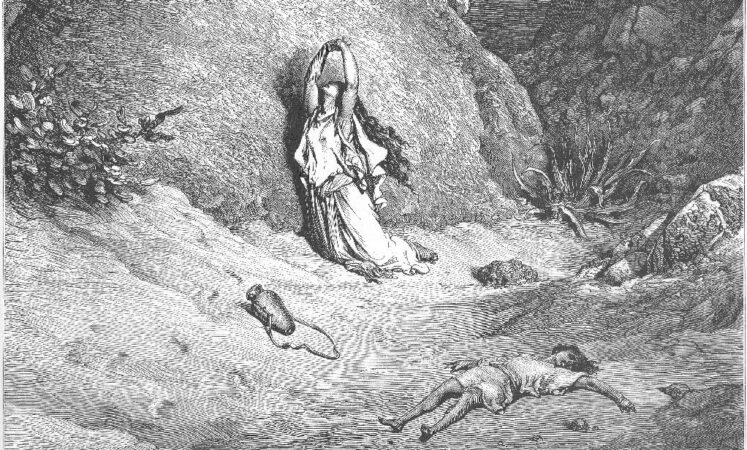
I was recently reminded that Theopolis had published a rejoinder to my argument, and it was an article I had failed to respond to for some reason. I don’t know why I didn’t, and in my defense I can only point to all the other peas that are all over the floor.
My thanks to Gabe Harder for his work, and my apologies for just now getting around to this. Here is the link to his article. If you are one of my Jewish friends, I would invite you to jump down to the last section and to read that part first.
It Is Freely Admitted . . .
One of the question that usually arises when this particular exegetical subject is raised runs along the lines of “where on earth did you get this? Has anybody else ever held this view? Like, anybody at all?” Questions of this nature had apparently occurred to Gabe—”one of the more curious features of his account,” “a true theological novum,” “seemingly idiosyncratic,” and “the ambiguous and bizarre nature of his previous comments.” One might even say, “out on the skinny branches.”
The best way to answer this concern would be to say that I don’t think my position about unbelieving Jewry is a theological novum at all, but rather mainstream Reformed, and that rather I am bringing to that standard position an additional argument. And where did I get that supplementary argument? I thought I was getting it from Paul in Galatians. Hear me out.
Let Me Lend You My Rosetta Stone for a Minute
Is the old covenant a covenant of law or a covenant of grace? That depends on who you are. Are you regenerate or unregenerate? Are you a son of God or a son of Belial? Are you an Israelite in whom there is no guile, or are you an Israelite who is full of guile? Are you an outward Jew only, or is your heart circumcised as well (Rom. 2:28-29)? To the unregenerate, even the gospel is the stench of death (2 Cor. 2:16). To the regenerate, even the law is the perfect law of liberty (Jas. 2:12).
Under the law, every mouth is stopped (Rom. 3:19). And the law of the Lord is also perfect, converting the soul (Ps. 19:7). What is going on here? Which is it? The answer is that it depends on who you are, which in turn depends upon what God has done in your heart.
Paul tells us that the righteousness that is “of the law” speaks in a particular way, and he quotes Moses from Leviticus. “For Moses describeth the righteousness which is of the law, That the man which doeth those things shall live by them” (Rom. 10:5; Lev. 18:5). When the Torah speaks, the Torah speaks law. And Paul also says that the righteousness which is “of faith” speaks in quite a different way, and here he quotes Moses from Deuteronomy. When the Torah speaks, the Torah speaks Christ.
But this is not Moses pitted against Moses. No, not a bit of it. It is Moses as seen and understood by an unregenerate heart and Moses as seen and understood by a regenerate heart. But in presenting the law to us in this way, God knew that the law would be approached and. understood in these two different ways. God budgeted for these two different ways of looking at His Word. He gave the gift of light and life to some, and He poured out a dark stupor, a blindness in part, on the others (Rom. 11:25). There was therefore a covenant to be kept by faith alone, and there was also a “covenant” to break covenant, doing so by twisting the law into a system of self-justification.
“For Christ is the end of the law for righteousness to every one that believeth.”Romans 10:4 (KJV)
Those who look through the window of the law, and see Christ, these are children of the free woman. Those who stare at the mural of the law, and see a painted ladder by which they are going to try to climb up to heaven, these are children of the slave woman.
So in the old covenant, covenant-keeping was by faith alone, and saw Christ as the end and purpose of the law. Those who did not have such evangelical faith saw only a mechanism by which they could go about to establish their own righteousness (Rom. 10:3).
“This covenant of grace . . . was differently administered in the time of the law, and in the time of the gospel; under the law it was administered by promises, prophecies, sacrifices, circumcision, the paschal lamb, and other types and ordinances delivered to the people of the Jews, all foresignifying Christ to come . . .
Westminster Confession 7.4-5
The old covenant straight up is, in its essence, an administration of the covenant of grace. But not all see it that way. The Pharisaical heart hates treating it that way, and so turns away from Sarah in order to embrace Hagar.
Galatians 4
As I read some of the back and forth among some of my friends over all of this, I found myself agreeing with a number of the objections, but in a way that revealed that they weren’t really objections to my actual position at all. So let me walk through what I think Paul is addressing in the last part of Gal. 4, trying to state it in such a way as to anticipate and answer more clearly—than I have to date—some of the questions that have been raised. After that, I will have a few brief responses to Gabe Harder’s article.
The passage in question begins in this way:
“Tell me, ye that desire to be under the law, do ye not hear the law?”Galatians 4:21 (KJV)
Who is being addressed? Who is Paul talking about? There would be two categories of people to whom this would apply. The first would be any members of the Galatian church who were wavering, wanting to return to Judaism. They were toying with a desire to go back “under the law.” And they were being enticed by men already in the second category, those being the Judaizers who were recruiting them, men who were already under the law.
Now the law here is the Torah, the word given to Moses. We are not talking about Buddhists and the Noble Eight-Fold Path. And we are not talking about non-Christians generally. We are talking about those who want to live under the Mosaic law.
Now people who wanted to do that were around in Paul’s day, and they are still around in ours. One of the more curious facts of religious history is the durability of the Jews—over the course of two thousand years. Nobody that I know has any acquaintance with any Hittites. The Amalekites are long gone. The Amorites are a spent force. But the Jews are still here, and the word tenacity comes to mind. And conservative Jews today, the ones who actually want to practice their faith, want to be “under the law.” Paul therefore invites them to hear the law. How on earth would his reasoning here not apply to them?
A blindness in part has been assigned to them (Rom. 11:25). God has poured out a spirit of slumber upon them (Rom. 11:7-10). Paul tells us that whenever the Old Testament is read, they are blinded by a veil (2 Cor. 3:14-15). Do they not still read the Old Testament? Do they not gather in synagogues on a weekly basis to hear it read to them? Do they not gather at the Wailing Wall to pray, the very Wall that stands as an authenticating ruin, testifying that Jesus was the true Prophet who was to follow Moses (Dt. 18: 15)?
The men Paul was addressing had rabbis, and rabbinical schools of thought, and synagogues, and the Hebrew language, and genealogies, and a shared rejection of the Christian gospel. We still have all of that. So what about 70 A.D. would make this passage inapplicable?
So Abraham had two sons. One was born of the slave woman, and the other, the child of promise, was born of the free woman (v. 22). The one born of the slave woman was born “after the flesh,” that is, in the ordinary way. The son of the free woman was “by promise” (v. 23). The fact that this was sheer grace and the result of a fulfilled promise was underscored by the fact that Abraham was 100 and Sarah was 90 when this happened. So it clearly happened because of the promise. The giving of Isaac was not ordinary.
So Paul is saying that unbelieving Jews are spiritual Ishmaelites, sons of the slave woman. He is not saying that this is literally true. It is, he says, an allegory (allegoria).
“Which things are an allegory: for these are the two covenants; the one from the mount Sinai, which gendereth to bondage, which is Agar.”Galatians 4:24 (KJV)
What are these two covenants? The one that “gendereth to bondage” cannot be the old covenant simpliciter. The old covenant understood rightly, that is, by faith, is all about Christ—Christ being the telos of the law (Rom. 10:4). So Christ is not bondage; He is liberation itself. Abraham saw the day of Christ, and he rejoiced in seeing it (John 8:56). All the true sons of Sarah do the same—they see Christ in everything. So the Mount Sinai referenced here is the Mount Sinai that is being stared at in the light of Leviticus 18:5. But when Moses looked at the mountain, what he saw was the cloud where Christ was, and he went up to commune with Him.
“For this Agar is mount Sinai in Arabia, and answereth to Jerusalem which now is, and is in bondage with her children.”Galatians 4:25 (KJV)
I think there is likely some kind of linguistic or historical connection between the word Hagar and the word Sinai, one that we are not aware of. So Paul somehow connects the two, and says that this particular blind vision of Sinai is characteristic of the Jerusalem that “now is.” The city where Jesus was crucified was ruled by evil men who thought this way. The Jerusalem that “now is” was the place where various attempts had been made on Paul’s life.
“But Jerusalem which is above is free, which is the mother of us all.”Galatians 4:26 (KJV)
The heavenly Jerusalem is Sarah, the free woman. As the free woman, her children are all of them freeborn. The Christian Church is therefore the true Israel.
“For it is written, Rejoice, thou barren that bearest not; break forth and cry, thou that travailest not: for the desolate hath many more children than she which hath an husband.”Galatians 4:27 (KJV)
Paul then quotes Isaiah, a great prophetic book that is crammed with references to the remnant of Jews who would be saved, the number of Jews who would be turned over to a judicial blindness, and an establishment of a greater Israel made up of Jews and Gentiles both together. And then there is this passage, which makes the parallel between Sarah and the Jerusalem above explicit. Both of them were barren for a long time, but look at them now.
“Now we, brethren, as Isaac was, are the children of promise.”Galatians 4:28 (KJV)
We Christians, just like Isaac, are the promised children. Not literally, but spiritually. Isaac was the promised child of Abraham, and all of us who have been baptized into Christ are promised children of Abraham (Gal. 3: 27, 29).
“But as then he that was born after the flesh persecuted him that was born after the Spirit, even so it is now.”Galatians 4:29 (KJV)
And this explains the hostility that Christians were suffering at the hands of the Jews. Just as Ishmael had taunted Isaac, so also the children of the flesh had it in for the children of the promise.
So sons of the slave woman don’t see Christ in anything. Within the Abrahamic household, there is a covenant of bondage. There is a slave wife, and she does bear Abraham a son. However, not only is she a slave wife, but she is a slave wife who is then put away. Not just a concubine, but a divorced concubine. But the child still has a typological connection of some sort to his father. Ishmael was not a bastard. Not a bastard, but not an heir either.
“Nevertheless what saith the scripture? Cast out the bondwoman and her son: for the son of the bondwoman shall not be heir with the son of the freewoman. So then, brethren, we are not children of the bondwoman, but of the free.”Galatians 4:30–31 (KJV)
Quick Responses
“Despite acknowledging Paul’s appeal to the Genesis narrative here as metaphorical, in some places it actually sounds as though Wilson is arguing that unbelieving Jews are made participants in a historical covenant with Hagar and Ishmael.”
Gabe Harder, Reconsidering Doug Wilson’s “Covenant With Hagar”
No. I am arguing that the covenant that unbelieving Jews are operating under is one that is typified by the divorce and banishment of a slave wife, together with her son. The Jews are not literal Ishmaelites . . . any more than Herod the Great was a literal Pharaoh when he was killing the baby boys. But he was a Pharaoh nonetheless.
“Paul is clear that his appeal to Genesis is allegorical; the covenant, therefore, is not with Hagar, rather Hagar is the covenant (Gal. 4:24).”
Gabe Harder, Reconsidering
Yes, it is certainly allegorical, but it is an allegory with more moving parts than just the old and new covenants. If Hagar is the covenant, then in what way was she failing to keep it? Why was she put away? She was put away because the child of the flesh was taunting the child of the promise. The son of the slave woman was taunting the true heir. There are two things going on in Abraham’s household—flesh and promise. Right? If Hagar was the covenant, period, then what was Sarah? Sarah represents OT covenant faithfulness and Hagar represents OT covenant works-righteousness.
The allegory makes no sense otherwise. The allegory makes no sense unless we fit both women into it.
“Put simply, Hagar is the Old Covenant considered apart from its fulfillment in Christ.”
Gabe Harder, Reconsidering
The Old Covenant considered apart from Christ is like looking at Lake Superior, but without the water. The Old Covenant apart from Christ is not the Old Covenant. And those Jews who think that such a thing is possible are simply demonstrating that they are children of the slave woman. The Old Covenant without Christ is a distortion of everything, and therefore inherits nothing.
“That argument culminates in the allegory of chapter 4, where, as summarized concisely by John Stott, “the two women, Hagar and Sarah, the mothers of Abraham’s two sons, stand for the two covenants, the old and the new, and the two Jerusalems, the earthly and the heavenly.”
Gabe Harder, Reconsidering
Mostly yes, but no to one crucial part. The two women do stand for two Jerusalems, the earthly and the heavenly. And they do stand for two covenants because the old covenant is a covenant of grace, and that’s Sarah. So what is Hagar then?
And if you make Hagar the complete representative of the old covenant, then you have rejected WCF 7.4-5, and have no place in the older economy, or in the allegory, for a faithful Sarah.
“This means that the Hagar covenant did not begin in the 40’s AD; it was the experience of unbelieving Jews bound to the Sinai covenant throughout history, only now exposed as abject slavery.”
Gabe Harder, Reconsidering
But the problem is that believing Jews were also bound to the Sinai covenant throughout history—only the cords binding them were woven out of faith. The legalists were bound to Sinai with cords of “pedal harder.” Like Boxer in Animal Farm.
So I agree that the Hagar covenant did not begin in 40 A.D. It was a perennial thing, going back to Genesis, and it did not end in 70 A.D. We still have Jews, we still have Moses being read, we still have a veil of unbelief, and we still have the promise that they will one day look on the one they pierced (Zech. 12:10).
“What is simply indefensible, however, is the notion that the Old Covenant order typified by Hagar endures to the present.”
Gabe Harder, Reconsidering
No. This misconstrues the entire argument. It is not that Hagar typifies the Old Covenant order, and that this exists to the present. Of course not. Had I in fact argued that, it would be indefensible. The only way that covenant faithfulness can endure down to the present is through Christ. What Hagar typified was a distorted approach to the old covenant, and that distorted approach most certainly exists today.
How could it not?
A Brief Word to My Jewish Friends
I know it seems odd and somewhat awkward to be reading this kind of discussion among Christians. Two of your friends are arguing about you, and with you standing right there. You want to interrupt and say, “You do know I’m here, right?” Yes, I know, and want very much to be mindful of it.
I am a Christian, and the central claim of the Christian faith is the Jesus rose from the dead, thus vindicating His office as the Messiah of Israel. Practicing Jews deny the claim, and Christians affirm it. That is a place where it is not really possible to split the difference. Jesus either rose from the dead or He didn’t. If He did, then you Jews are most frightfully deluded. If He did not, then we Christians are the hopeless ones (1 Cor. 15:19).
Having said this much, it should be possible for us to interact with one another as though we were civilized human beings, doing our best to identify our actual differences, and without getting dragged into controversies where the differences are not essential, or worse, imaginary, or worse yet, malicious. So I appreciate very much those of you who read my American Milk and Honey, and who understood the thrust of my arguments, as well as the spirit behind it. I am greatly indebted to you for that.
It is a matter of some astonishment to me that you can read the kind of arguments I make above, and still see clearly that I am a friend. Thank you. And it is a matter of greater astonishment that some of my fellow Christians will read it, and come to the conclusion that I am about to be ordained as a rabbi. Oh, well. Wisdom is vindicated by her children.