

I have noticed that I have been asked more questions about the 19th Amendment over the last year or so than I had ever been asked in all of my life prior. There is of course some sort of strategy behind all the questions, which is usually aimed at discrediting our larger project, and so some friends have therefore wondered about what reasons I might have for even answering the questions. I subsequently hit upon the device of addressing all the questions in one go, through the construct of an imaginary interview. That way I can just refer people here.
So this interview is with the Intelligent Women’s Examiner, a publication which does not share my views, and is not in sympathy with them, but which nevertheless sent a couple of competent reporters who knew enough to not give way to hysterics upon encountering my troglodyte views.
So here we go.
IWE: Thank you very much for agreeing to sit down with us.
DW: Happy to do it.
IWE: Let’s begin with what we think would be the obvious question. Do the women in your family vote?
DW: Yes, of course. And in another respect, in a different realm, no.
IWE: All right, please explain.
DW: They all vote in civic elections. My wife votes, my daughters vote, my daughter-in-law votes, and my granddaughters, those who are old enough, vote. If I were a Democrat, and lived in Fulton or Maricopa County, my great grandmother would still be voting.
The no would be because they don’t vote in our church elections—according to our polity, our congregation votes when we are electing deacons and elders, and in calling a pastor. In these elections we all vote by household, and those votes are cast by the head of the household. We have been doing it that way for decades now, and with not one complaint about it.
IWE: So you are willing to say out loud that the women in your church don’t have any say when it comes to the selection of officers in your church government?
DW: Household voting is not a mechanism for taking away anyone’s “say.” It is a different mechanism for routing that say, one that includes and takes into account the most important relationships a woman has.
So our women as individuals don’t have a voice in the voting process, but neither do the men as individuals. When the household is discussing what they are going to do, of course they have a say—not in the voting process, but around the dinner table. So I am simply emphasizing that in our system, the entire household votes.
Now, as it happens, I would estimate that in our church elections, the number of votes cast by women would be between 5% and 7%. These would be women who are widows, or divorced, or unmarried women in a household of one. The Scriptures clearly describe Lydia, for example, as the head of her household (Acts 16: 15). If she were a member of our church, she would cast the vote for her household.
So what we are doing is not a matter of XX and XY chromosomes at all. It is not a question of recognizing only males and refusing to recognize females. It is the result of a deep desire to recognize households. We want our households to be recognized as governmentally significant.
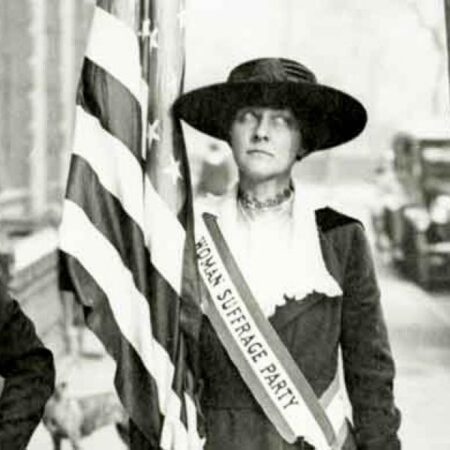
In the civic realm, the 19th Amendment, by giving the franchise to women as individuals, transformed male voters into mere individuals, and wound up disenfranchising the household. So the issue for me is not who got the franchise, but rather who lost it.
IWE: Just a point of clarification. Do you have household membership also?
DW: No. Membership is reckoned individual by individual. Members need individual pastoral care. People come to the Word and sacrament the same way people go to Heaven, as individuals. But voting is an act of governance, not a sacrament.
IWE: Why is this issue so important to you?
DW: Because we are Christians, not libertarian individualists. We do believe in the value of individuals, certainly—we go to Heaven or Hell by ones, after all—but we also believe that the basic building block of every healthy society is the household. I will no doubt have occasion to quote Dabney again in this interview, but his comment here is pertinent. “The integers out of which the State is constituted are not individuals, but families represented in their parental heads.”
IWE: You are acting as though this is a really big deal . . .
DW: Absolutely, yes. In a society governed by the individualist and libertarian assumptions, everything becomes necessarily atomistic. Not only so, but over time it will become more and more atomistic. Each person is a BB, and we throw all the BBs into a sack, something that has all the structural integrity of a bean bag chair. The only thing holding it all together would be the sack, which is the state. And then we compound all our societal woes by greasing all the BBs with a couple of quarts of 10W-40 oil—you know, with things like easy divorce, ubiquitous porn, and cannabis shops everywhere. Nothing holds together any more, and personal covenanted loyalty is all vanished and gone. The center no longer holds. The best lack all conviction and the worst are full of passionate intensity. And so here we are. Look around.
In contrast to this, we believe that every healthy culture—and every healthy subculture, like a church—is something that has to be molecular, and that the essential building block of every complex molecule is going to be the family. This is why we vote in the way we do, and why I have written about twenty books on marriage and family. These are Burke’s little platoons, and we honor them.
IWE: Whoa. Why are you standing on your chair?
DW: Sorry. I get worked up.
IWE: So if you feel all that strongly about it, why isn’t the repeal of the 19th Amendment a much higher priority for you? We have read your comments elsewhere that you have said repealing it is #257 on your list of priorities. Why so low then?
DW: Because politics is the art of the possible, and we have other issues that are far more pressing. The passing of the 19th Amendment introduced a torrent of these evils, certainly, but there are quite a few of those downstream evils that are a more immediate threat. I am speaking of things like the murderous practice of abortion, and the charade of same sex mirage.
IWE: But you do think the 19th Amendment was a bad idea?
DW: It was a terrible idea, and for all the reasons cited. Let me give you an example of what I mean. Let me connect the dots for you. Conservative Christians are very grateful for the Dobbs decision, the one that overturned Roe. But we can still go back to Roe to illustrate what I am talking about. In that infamous decision, the Court determined that the decision to kill a child in the womb was a decision to be made by a woman and her . . . her what? By a woman and her doctor.
Roe not only authorized the slaughter of millions of babies, which was its very own horror, but it was also the abortion of the American family—collateral damage that was scarcely even noticed. When it came to the murder of his own legitimate child, the father of that child had no legal standing whatever to prevent it. He may have bound himself to his wife covenantally, financially, legally—all the ways—in a church, with a multitude of witnesses there, but as far as the Court was concerned, he was now a nullity. And what a travesty that was. A legitimate father had no recourse or standing to save the life of his legitimate son or daughter. The Court banished fatherhood in that moment, and turned all the men of our country into sperm donors.
IWE: So you seriously link those two issues? Women’s suffrage and the abortion controversy? Isn’t that kind of arbitrary? Women having a say in how the country should go and women deciding to abort a child are two very different things . . .
DW: Of course I link them. And I am not alone in this, having plenty of company. It was Obama who said “from Seneca Falls to Selma to Stonewall.” I agree with him about the trajectory, and merely differ with him over whether it was a good thing or not.
Was suffrage called a women’s issue, even though many women at the time opposed it? And is abortion called a women’s issue, even though many women today are ardently pro-life? The progressive left draws a straight line from that earlier women’s issue all the way through to this later one, do they not? The two are marked as essential parts of the ongoing “emancipation of women.” I regard the two as actually essential parts of the ongoing demolition of womanhood. So it can hardly be an outrage if I make the same linkage, correct? I am just on the other side, that’s all. If there is outrage about it, that would be why.
IWE: To use the word demolition here is kind of extreme, don’t you think?
DW: Tell that to women athletes.
IWE: And did you just use the word womanhood?
DW: Sorry. Shouldn’t have done that. I am not a biologist (laughs).
IWE: Okay, but what do you say about the many conservative Christian women today who would disagree with you about the 19th Amendment? We can imagine that most of them would take strong exception to your views.
DW: Well, the first thing I would do is try to find out if we actually disagree or not. If they simply think that tactically we ought to be mobilizing every conservative vote we can, women included, so that we can defeat the current encroachments of the commie left, I quite agree with them. See my earlier comments about all the women in my family. They vote, and they vote more wisely than millions of men do. Fine. I have no interest in cutting the conservative vote in half at the very same time that the left is pushing to expand the franchise to every illegal alien in southern California.
It is just that I see the deep connections in every attempt to expand the franchise. You know that many on the left ardently believe that non-citizens, illegal aliens, should be able to vote. And my point is this: the leveling philosophy that got us to this absurd point is a philosophy that has been operating for more than a century.
But back to your question, I would actually agree with the women who mistakenly believe they differ with me tactically.
IWE: Is there a “but” coming?
DW: Yes, there is, and here it comes. But I would also say something very different to those conservative women who are personally offended by, for example, the mere fact of our household voting in the church. That they are somehow affronted on a personal level means that they are simply first wave feminists. Like other sectors of the broader Enlightenment project, feminism does have a right wing, and that includes the ladies who voted for Trump but who also want their daughters to be kick-ass fighter pilots.
IWE: So it sounds like you believe that the rough and tumble of politics is bad for women?
DW: Yes. I believe that political strife has a much more profound impact on women than it does on men. This helps explain the lunatic behavior that now passes for normal in the public square. Where did all these disturbed harpies come from? Dabney again: “Political excitements will corrupt women tenfold more than men; and this, not because women are naturally inferior to men, but because they are naturally adapted to a wholly different sphere.”
But let me also add that I do recognize that there are women who have retained a biblical femininity despite being politically active in conservative causes. My hat’s off to them, and I do not deny their existence. However, I will also add that all such women have to make a point of guarding themselves in a particular way that the men don’t have to.
IWE: So you think the blame for all our modern ills should be laid at the feet of the 19th Amendment?
DW: No, actually. The culprit is egalitarianism, and the feminism is just a subset of that. I believe that the 19th was a really bad step, but there were other issues that prepared the way for it. The franchise had earlier been expanded from freeholders to any white males, and that was bad too. That was a real downgrade. I believe that there should be property qualifications for voters because otherwise, as the saying goes, democracy is just three coyotes and a sheep voting on what to have for lunch.
IWE: Anything else you want to get off your chest? This appears to be sharing time.
DW: Yes, and thanks for asking. The 17th Amendment was really bad also. All of these problems are part of the backslide away from the principles of the Founding. We were founded as a constitutional republic—”a republic, if you can keep it”—one that had its solitary democratic element cordoned off in the House of Representatives. The Senate was supposed to be the place where the states as states were represented. Notice again the recognition of corporate entities other than the individual. So the direct election of senators was part of our ongoing and slow motion downgrade.
I am not a big fan of the 26th Amendment either, lowering the voting age to 18. And I think the Electoral College is one of the greatest things the Founders ever did. Just genius.
IWE: Do you understand why all of this sounds so offensive to modern ears?
DW: Yes, I do, actually. This is because voting has been transformed from a way of making sensible and equitable decisions for the good of society as a whole, and has been turned into a mystic sacrament. And the people who are usually all about mystifying the sacraments are those priests standing behind the idol, waving their hands over it and running the con.
IWE: What do you mean by “mystic sacrament?”
DW: Instead of a practical way to make decisions, it has become a means to commune with our divine mother, the state. This is why discussion of abandoning the 19th Amendment strikes people as being tantamount to a civic excommunication. But it is nothing of the kind. On a practical level, all else being equal, if they are of one mind, having both the husband and wife vote simply multiplies the final vote tally by two. And if they differ with each other, with the husband voting for Murphy and the wife for Brown, they are simply going to cancel each other out. They might as well stay home and have a nice romantic dinner. That might even lead to the conception of a future voter, and be far more profitable to the future of democracy. More fun than voting too.
IWE: Do you know what incorrigible means?
DW: Yes, I think I do.
IWE: Back on track. You are speaking as though introduction of women into a previously all-male space is the end of the world.
DW: It is not the end of the world, but it most certainly is the end of a world. It is utterly transformative. It is simply not the case that women can ever be included in an all-male space. As soon as they arrive, it is a completely different kind of space simply because they are there. A woman is never experiencing what the guys were experiencing before she got there. There is such a thing as an all-male space. There are co-ed spaces as well, and God bless them. There are all-female spaces. But there is no such thing as an all-male space with women in it.
This applies to clubs, to boards, to Annapolis and West Point, to submarine crews, and to political campaigns and the public square. None of these things are “the same thing” only with women present now. They are altered fundamentally.
IWE: What is the nature of the alteration?
DW: I am indebted to Helen Andrews for the pithiest expression of what has happened to us as a result of women coming into these spaces in large numbers. She calls it the “HRification” of everything. Men and women tend to view conflict differently. Men think of conflict as one of the means for making progress, as one of the necessary tools that will get us to a solution. Women tend to view conflict as the problem that must be solved. All conflict must therefore be suppressed. And from this we get all the woke nonsense, with busybodies trying to stomp out all the micro-triggers. I think it is useless to deny that this paradigm is now the dominant one in our public discourse. And I think the 19th Amendment was one of the original culprits.
IWE: We know plenty of men who would disagree with this assessment of yours.
DW: You don’t know that for sure. Maybe they just don’t want to get reported to HR.
IWE: So then . . . whether you are successful in persuading anyone of this or not, and as much as we might hate to admit it, it seems that you are at least striving to articulate this position in a way that, for modern ears, is not manifestly insane. There are points in all this where you are seeming almost reasonable.
DW: Thank you. High praise indeed.
IWE: What do you say about those figures on . . . I believe your phrase is the “dank right” . . . those figures on the dank right who seem to exult in being as offensive on this subject as they can possibly be? They attack the 19th Amendment too, just like you do, and if you ask a question about it they say, “Silence, wench.” You at least seem to be trying an approach that is different from theirs. Why is that?
DW: Well, thank you for noticing. That’s something, at any rate. I would divide those strident voices into two camps, with two different motivations.
IWE: Those being what?
DW: The first category would simply be the opportunists. They are outrage farmers, and are willing to say or do whatever it takes to get the clicks. Rage clicks are clicks, after all. They have isolated and identified the big time taboos that were enshrined by the post war liberal democrats, and have set about to be as transgressive as they can be with regard to those taboos. They think there is a ready market for being transgressive in this way . . . about women, about Jews, about blacks, you name it. They are surfers, trying to identify the big one, so they can ride it.
IWE: Do you think they are right? You seem to agree there are big issues involved . . .
DW: No, and then down road, a different kind of yes. They are misreading all the important aspects about the moment we are in. They believe there is currently a market for their naughtiness, and they are right about that part. But it is a reactionary market, not a reformational one. That means it is momentary and transient. But the historian Christopher Dawson once said that the Christian church lives in the light of eternity, and can afford to be patient. And the hallmark of reactionary or revolutionary movements is their impatience.
Allow me to quote Winston Churchill on the point. Before the war, he and Hitler were both in Munich for a short time, and Churchill’s son Randolph attempted to arrange a meeting between them, through a German intermediary by the name of Hanfstaengel. The meeting never materialized because Hitler didn’t show up for it. But in their conversation, Churchill told Hanfstaengel, “Tell your boss from me that anti-Semitism may be a good starter, but it is a bad sticker.”
These guys have picked up on a whole array of good starters and bad stickers. Surliness, hatred, bad attitudes, and demagoguery do not an eschatology make.
IWE: So what is the second category you have in mind?
DW: There really is a great deal of misery and unhappiness among young, white, masculine, heterosexual males. They have come of age in a generation that has treated their whiteness as a cancer, their masculinity as toxic, their sexual interest in women as objectifying, and every breath they exhale as a pollutant. This rising generation of young men is far more conservative than their female counterparts, both politically and theologically. Even among Christian women, they have trouble finding a woman who isn’t at least somewhat feminist. This cohort is not in it for clicks, and they genuinely don’t know what to do, or who to believe. It is more existential for them. They will give anyone a hearing, including some of the demagogues, and the only group they have trouble listening to would be the establishment voices that have been lying to them their entire lives. This is unfortunate because the establishment didn’t get absolutely everything wrong. It is a baby and bathwater thing.
IWE: You want to reach those in this group, is that it?
DW: Very much so. The last thing they need is to have something else collapse under them again. The very worst thing to land on them would be a “good starter and a bad sticker.”
IWE: One last question, going back to the question of why we are even discussing this at all. Why can’t you just embrace a conservatism that is content to fight the current battles? Why resurrect a controversy from a hundred years ago?
DW: Two things in response. I am not the one who resurrected it. I know that eventually we would have to deal with that issue, but I confess that we have our hands full fighting the current battles. But it was CNN who asked us the question. Repealing the 19th Amendment was not part of our big PR campaign.
IWE: Fair enough, but I sense another but coming . . .
DW: But I need to summarize Dabney again, if you will permit me . . .
IWE: You do know that Dabney was a die hard Confederate . . .
DW: I already like him. You don’t have to sell me.
IWE: All right, channel Dabney for us.
DW: The novelty of yesteryear gradually becomes one of the accepted principles of contemporary conservatism. The conservatives are only conservative in the sense that they resist the next lunatic innovation. They, not having any real first principles, will lose that fight also, and the next innovation will be imposed upon their cowardice and timidity. This will be followed by some third revolution, to be denounced in its turn before being eventually adopted. And here is the part I know verbatim. “American conservatism is merely the shadow that follows Radicalism to perdition.” It tags along behind, never actually retarding the progress of the progressives. It is a pretend salt, and has utterly lost its savor. How will it ever be salted again? This impotence is not hard to explain—it is worthless because it is a pragmatic conservatism, interested only in expediency, and never sturdy principle. “It intends to risk nothing serious for the sake of the truth, and has no idea of being guilty of the folly of martyrdom.”
And this is how the Overton window has moved so far left, actually. Most modern conservatives are fully content with merely slowing the progressives down. After the travesty of women in combat was established, it took Fox News about ten minutes to begin lauding “our brave men and women in uniform.”
Now I have no problem with incrementalism, but it really ought not be an incrementalism that redefines victory as “losing slowly.” There is another sort of incrementalism, one that slowly undoes the actual gains of the progressive left. But it is not possible to achieve this if you have no actual idea of what those long term reversals might look like. I do know what they look like, and if asked about it, I will answer honestly.
IWE: Well, thank you for doing that here . . .
DW: You are most welcome. This should keep your readers on edge for at least a few years.