

Introduction
Last week Eric Erickson published an article that claimed to have connected a lot of dots on what has come to be called the Woke Right. That article is here. He traced a lot of our woes back to Charles Haywood, a big donor on the hard right, and formulator of the “no enemies to the right” approach, and which Erickson claimed has led to lots of bad stuff.
My purpose here is not to enter into the fray, at least not directly. What I mean is that I want to try to outline a third position here. In doing so, I hope to describe certain aspects of this conflict in a way that might perhaps ameliorate some aspects of it. Not all aspects of it, but some. Some of the conflict needs to continue because the problem that Erickson is attacking is not an imaginary one. It does exist, and to have ongoing conflict there is not a problem. It would be a problem if there were not continued conflict there.
But some of the conflict really needs to subside and go away because it was simply unjust, ushering in additional murk and confusion.
The Structure of an Inflamed Debate
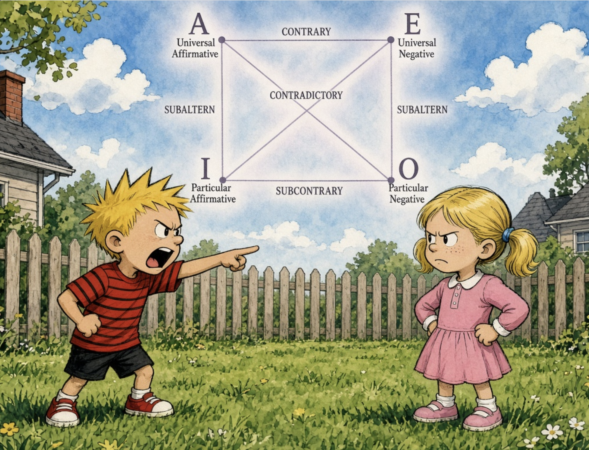
Imagine a little boy and girl arguing, the way Calvin and Suzy would. The boy maintains that “all girls are stupid.” The girl, thinking to answer him in the most forceful way possible, maintains to the contrary that “no girls are stupid.” But while this response matches the accusation in decibels, it is just as indefensible as the original accusation. On the square of opposition All P are Q and No P are Q are contraries, but the true contradiction is Some P are not Q.
All those who might vote for Vance are crypto-fascists is an indefensible smear. But equally indefensible is the retort that no one who might vote for Vance is a crypto-fascist. There really is a growing problem on the right, and some of it is not all that crypto. A dragnet approach in leveling charges is not helpful. Neither is it helpful for those against whom the charges are leveled to be all indignant, like a room full of wet cats, saying, “Nobody here but us chickens. There is no one of that description over here.”
C’mon. Of course there is. But it really is all of a jumble. We have Burkean conservatives whose only offense is that they really mean it. But we also have Christian nationalists who are transforming, as we speak, into Christian national socialists. That is two tons of no bueno. We also have people who are not Nazis at all, but they suffer from a peculiar affliction . . . they care about the Nazi gaze. They would ten times over prefer to be accused by David French of being a Nazi—that kind of charge is just white noise by this point—than they would want to be accused by a Nazi of being like David French. This peculiar flinch makes them preeminently manipulable.
With that said up front, back to Erickson’s article.
Who Was in View?
The editor’s note said this: “You guys always ask me to name names. Challenge accepted.” And then the first paragraph made crystal clear what was being alleged about all the named individuals and organizations. “A group of white guys have subtly inserted themselves into conservative institutions and church organizations. They all embrace racial grievances. To varying degrees, they embrace white nationalism, antisemitism, and even Nazi sympathies” (emphasis mine).
This established the genus that the article was going to populate by naming names. The different people and organizations named in the following article were intended to fill out that intended genus. And some of them were just plain wrong.
Life Is Not Simple
Eric Erickson published his article. Discussion ensued. Will Spencer, a friend of mine, retweeted Eric’s article, commending it. In that commendation, he said, “Like a detective, this work must be performed with precision. The process requires diligence and care.” The following Friday, last Friday, the same Will Spencer addressed the student body at New St. Andrews in our weekly Disputatio, and gave a talk on the wormhole right, a talk that was simply outstanding. Then Ben Merkle, president of New St. Andrews, and my son-in-law, tweeted that Erickson’s article did have a point, but that he also was using quite a broad brush, and that there was way too much paint globbed on it. As an example, Ben defended Nick Solheim’s American Moment which was initially tagged in Erickson’s article, and which nevertheless is not part of the dank right at all. A number of our New St. Andrews grads have worked quite productively with American Moment. Ben also defended Scott Yenor, a friend of NSA who was also named in the article. David Bahnsen, another friend of mine, took issue with Ben’s tweet online, defending Erickson’s article.
Okay, I am going to stand back for a moment to let you connect all those dots.
Life Is Not Simple, Part Two
When it comes to connecting dots, there is a methodological limitation involved, and I don’t believe that Eric Erickson budgeted for this limitation nearly as much as he should have.
In our world of political and cultural churn, conditions change. People change. Knowledge grows. Wisdom shrinks. Other people dissemble. Friends flake. False friends are revealed. Deals are made. Deals are broken. Contracts are signed. And your lawyers tell you that you cannot talk about why Murphy doesn’t work here anymore.
In the past, I have been associated with people I would be unwilling to be associated with now. In some cases, they just changed their views. In other cases, they were hiding their views for the purpose of steering us. In some cases, they made the calculation that it would be better to offend Moscow than to offend against the Revoice for Nazis approach.
Going in the other direction, there were people fifteen years ago who would blurb one of my books, but who wouldn’t touch me with a barge pole now.
So not only can things change, but sometimes they change quite rapidly. Calvin Robinson made an initial splash in his opposition to women priests. Good job, we thought. We had him on Man Rampant. And shortly after that he started to veer into what might be called interesting territory. “Calvin was a heretic, etc.” But when people who pray to pictures call me a heretic, I don’t feel even a little bit sheepish.
The Limitations of Connecting the Dots
So here is another little connect-the-dots exercise, leading to an erroneous conclusion, one that I know for a fact to be erroneous . . . but the premises are all correct.
My father knew Carl Henry, founding editor of Christianity Today, and was once in Bible study with him. Marvin Olasky, current editor of Christianity Today, gave me my first publishing opportunity with a mainstream publisher—Crossway. This happened when I got the contract from him for Recovering the Lost Tools of Learning. I used to write off and on for Books & Culture, a publication of Christianity Today, working well with the editor John Wilson. In 2009, Molly Worthen wrote a respectful profile of me for CT called The Controversialist, and that is still on their website. Christianity Today then gave me another major leg up when they published an online debate between me and Christopher Hitchens, a debate that later became the book Is Christianity Good for the World? and which also led to the documentary Collision. And I might be bringing coals to Newcastle by this point, but then in their fiction category my novel Evangellyfish won CT‘s book of the year in 2013. And Mark Galli, then editor, blurbed it, noting that it was not all that fictional. Is it not plain as day that I am a theological liberal, planted in the conservative world by CT in order to sow chaos and discord? Thank you for giving me this opportunity to come clean.
I wrote something some years ago on the problem with degrees of doctrinal separation, and connecting all the doctrinal dots That piece is called What Flies in Our Circles. This was back in 2010. The issues were more doctrinal back then, and less about kneecapping people who might want to support JD Vance for president, but the systems are all operating in the same basic way. And that is not a sign of health.
True Charges or Just Semi-Plausible Accusation?
The central Bond villain in Erickson’s piece was Charles Haywood. There is no problem at all with Erickson disagreeing with Haywood’s vision for America’s future. Sure, fair game. Go after it. I disagree with that vision also, and that is what political debate is for. The problem lies in attributing the views of one donor to anyone associated with any organization that received such a donation. Haywood has donated to American Reformer. Joe Rigney has written for American Reformer. So?
The point was made that American Moment had published a manifesto of Haywood’s, and then later took it down. The implication was that something nefarious was afoot. They clearly support Haywood, but are now trying to pretend that they don’t support Haywood!

But there are reasons for deleting something other than trying to hide your true intentions. Perhaps you reconsidered. Perhaps you learned more and decided that you disagreed. Or maybe you agreed with the content, but not with the strategy. Perhaps the person you commended did something after receiving the commendation that more or less ripped it. Maybe something else.
As an example of this principle that is close to the bone, after Eric received pushback from Ben Merkle and Yoram Hazony (and I suppose others) for unfairly tarring Nick Solheim’s American Moment, [it looks like] he went back and edited his article. I put [it looks like] in brackets there because I haven’t confirmed that it was edited. If the tweet above was from the article, it is not there now. However, if it was edited, considered in itself, that is an honorable thing to do. If it was wrong, then correct the mistake. But you can’t quietly scrub a comment when your comment is chiding someone for quietly scrubbing a comment. See above:
I know that I am the radioactive bad guy, but I published three books with Crossway—Recovering the Lost Tools of Learning, The Case for Classical Christian Education, and Writers to Read. Over the years, the Wilsonian luster wore off for them, and they decided to quietly excise me from their back catalog. Those books are now published by Canon. Now it could be that Crossway did this because they are trying to hide their secret affinity with the Moscow Mood, or it could be that the situation changed, and they decided they were not on the same page with me. But if you were in a conspiratorial frame of mind, you could do any number of things with the fact of a relationship that is no more.
Ill-Advised Comments
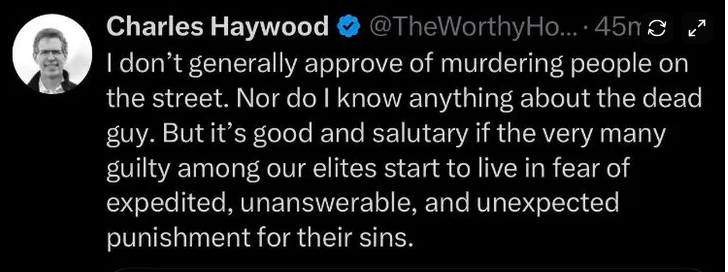
When political commenters are online a lot, and feelings are running high, it is sometimes possible to post something that is really awful, or that sounds really awful. Erickson’s article included a tweet from Haywood that is right in the middle of that category. He was referring to the CEO in the health care industry who was shot on the street. thus creating our recent assassination chic movement. There has been widespread admiration for the alleged gunman, Luigi. But . . . “I don’t generally approve?”
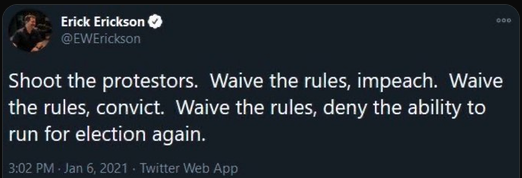
Eric rightly points to that sentiment as appalling. But in the midst of the J6 disorder, Eric himself tweeted this sentiment, off to the right. Twitter took it down, and Eric later said that he was talking about the police shooting violent protesters—as in the Floyd riots, so here. As an explanation, that part actually makes sense to me. But the deeply unsettling part for me is the thrice-repeated “waive the rules.” It is unsettling because it looks to me like this was in effect a call for a Protestant Franco.
And what do you do when a Claremont fellow like Tom Sauer loses his cool, and resorts to personal invective, aimed at Eric Erickson? “Peace, Eustace. Do not scold, like a kitchen girl . . .”
Love Your Adversaries
Part of the article was dedicated to a discussion of whether or not we need to love our public enemies, or if it is our duty simply to fight them. This is a false dichotomy. To love someone is to treat them lawfully from the heart—and a Christian man is to treat everyone he engages with in that way. I do treat public enemies and private enemies differently, but the difference should not be in whether I am loving them or not. You turn the other cheek with the latter, and not with the former. But I must treat all of them lawfully, and from the heart. Whether you turn the other cheek or not, you do whatever it is that you must do in love. This includes a Christian man’s conduct in a righteous war, and in lawful police action.
And it certainly includes a man’s behavior in the midst of a controversial melee among Christians. Part of the article was dealing with whether we are called to love the commies who are up to all kinds of mayhem, and who want to wreck our republic for good. Of course we are to love them, but let’s bring it closer to home, where it seems to be more urgently needed at the moment. How about all these Christians on the American political right having a go at loving one another? Just a suggestion. Treat Eric Erickson lawfully, from the heart. Treat Charles Haywood lawfully, from the heart. We here in Moscow need to treat the men in Ogden lawfully, from the heart. And so on. Now the recipient of your actions might not think it was loving, but what matters is that God does. God sees it all. This does not forbid collisions, but it does forbid the kind of thing we are starting to see now.
One of the grandfathers of the Christian conservative movement in America was Francis Schaeffer. That man did a lot of good, and he was a man of the hard right. At the same time, he cared about people, including the lost ones. People don’t think of him as hard right because he also cared about the fruit of the Spirit. The writer of The Christian Manifesto also wrote The Mark of a Christian and No Little People. Be like Francis. Fight hard. Hit hard. Hit hard, but above the belt.
Last Thing, Promise
It seems pretty obvious to me that this outbreak of hostilities on the right is the result of positioning in preparation for the Republican presidential primaries iof 2028. It seems to indicate a deep anti-Vance sentiment in some quarters, and lots of people are setting up for the brawl. People are gearing up.
For myself, I still want to wait and see who declares, and I want to watch them debate, and I want to read their position papers, and I intend to compare records, and all of that. But I want to do this like a civilized human being, and I think we should eschew all tactics like thumbs in eye sockets, biting off ear lobes, throwing sucker punches, and the like.
Why? Because when those festivities are over and done, the Democrats will have nominated some Menshevik or other. I don’t think any of us should say or do anything that would hinder or prevent our ability to work together in the face of a threat like that. The chances are really high that I would vote for the [yet unnamed] Republican nominee over against AOC. You know, really high. Would I place any limitations on that, in terms of our conservative cooperation right now? Yes, I would. Sure. There are limits. I would draw the line at cooperating with those “conservatives” who are in the process of becoming Mensheviks themselves.