

Introduction
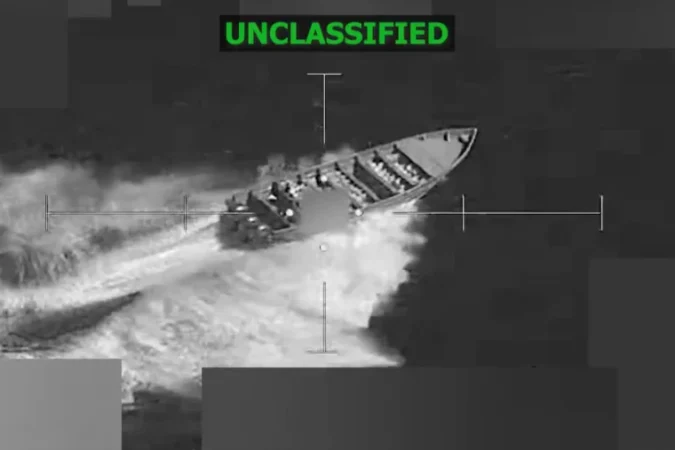
So let us turn our attention to a most fascinating question, one that will challenge and/or vex the usefulness of “Christian worldview thinking.” Our president has ordered the blowing of narco boats out of the water, that water being of the international kind, and this directive is being implemented by Pete Hegseth, our Secretary of War. Hegseth is also part of our communion of churches, the CREC. I am not Pete Hegseth’s pastor, but if I were, what kind of counsel would I give him on this? Is this even okay?
A Reasonable Question
So that we don’t get distracted by other issues, I want to limit this discussion to conservative believers. By this I mean that it needs to be limited to those who agree on the lawfulness and necessity of lethal military action under certain circumstances. And those circumstances are not made out of ideological wood. We are not leftists, who are enthusiastically in favor of violence from the air when Obama does it and violently against it if any Republican does. Neither are we pacifists, and so our discussion and debate needs to revolve around the nature of those circumstances. So what are they?
This is because we also would all agree that there is such a thing as unlawful military action, and that war crimes can occur. And so how can we tell what this kind of action is? I think we can all agree that Rand Paul is not a liberal bedwetter, and he sure doesn’t like what is happening, and so this means that reasonable questions can be raised.
Setting the Parameters
Let’s begin with a circumstance that I think we would all agree would be unlawful. Suppose there was a major drug deal going down outside of St. Louis in a deserted warehouse. Our intel on the drug deal was really solid, and we knew that absolutely everyone in the building was a bad actor with a long criminal record. So that there would be no complicating questions after the fact, the government surreptitiously bought the warehouse the month before. There were ten tons of fentanyl in there, and suitcases full of cash lying around everywhere. Now suppose, for the sake of our thought experiment, that the president ordered a drone strike and blew up the warehouse.
On a lawfulness scale, one to ten, that would be a one. Utterly unlawful and murderous. Okay, glad we agree. Good to have this little chat.
Now let us create a circumstance that would be a ten. Suppose again that our intel was slam dunk good, and we knew for a fact that Venezuela was manufacturing massive amounts of fentanyl and smuggling it into the US. Repeated diplomatic attempts to deal with the problem had been rebuffed. Suppose further that the president then went to Congress, and asked for a declaration of war, and let’s say he got it. Because we want to keep this thought experiment at a ten, let’s say that Congress declared war without one dissenting vote. The president then launched an attack on Venezuela, overthrew the government, and replaced it with a government that was hostile to the cartels. I think that there would be widespread agreement among us that this was a ten. Clear, clean, and justified.
But now let’s change things up a bit. Let us say that a fleet of pirates was operating out of Venezuela, flying the Jolly Roger and everything. They were doing all the bad things that pirates usually do, but they were freelancers. They were able to operate because of a wink and a nod from the Venezuelan government, but they were not functioning at the behest of that government. They were able to operate there because of a combination of intimidation and corruption.
Now let’s suppose that the president declared that any ship sailing in the Gulf of America while flying the Jolly Roger was fair game, and that the skull and crossbones did not count as free speech. Would we have a problem with him blowing up pirate ships under such circumstances? I don’t think so because . . . you know, pirates. Where is that on our scale—an 8 maybe?
To the Shores of Tripoli
In the early nineteenth century, the United States got involved in “warlike operations” against the Barbary Pirates, who had been preying upon American merchant shipping. The Pasha of Tripoli declared war on us, but we never declared war in return. Thomas Jefferson at first authorized our navy to take defensive military action, and this was expanded later, with congressional approval, into offensive warlike operations. The fighting began in 1801 and was ended with a regular treaty in 1805. Jefferson took action on the basis of his Article II authority as Commander in Chief, coupled with his deference to Congress on any offensive measures. So those proceedings were halfway between what we call kinetic military action and an actual war.
Now the Constitution authorizes Congress to declare war (as distinguished from “making” war) so as to give the Commander in Chief leeway to repel an invasion, for example, without have to go to Congress first. Mark this point.
But in the meantime, Jefferson’s scrupulous adherence to presidential and congressional prerogatives has evolved into something else much less creditable. We now have a thing called Authorized Use of Military Action (AUMA), in which Congress okays something military-like, but which somehow absolves them of any responsibility for having declared war—when what they authorized was in fact an actual war. The toppling of Saddam Hussein’s regime in Iraq is a case in point. Representatives could vote for war, but then become immediate critics of everything that was going on because they didn’t mean for the president to do it “that way.”
The last time Congress declared war was in 1941, right after Pearl Harbor. There was no declared war in Korea, in Vietnam, in Iraq, or in Afghanistan—and there really ought to have been. This is one of the indicators of our constitutional disease. But there does not need to be a declaration of war in fighting Somali pirates, or rescuing hostages, or any limited operation of that sort—and there never has been.
Now to the Narco Boats
So a boat full of drugs is sailing toward the United States. Incidentally, one criticism has been that these boats don’t have enough fuel to get here, they are not ocean-going, etc. That would just mean they are on their way to a rendezvous, to a drop-off point. They are either coming here with the drugs, or they are shuttling the drugs to someone else who is coming here. Either way.
Let us stipulate that our intel needs to be excellent, and that we need to know beyond a shadow of a doubt what is in the boat, and who is driving the boat. If we were to blow up an actual fishing boat by accident, it would be agreed upon by all that this would be really really bad.
Now if the president appeals to his authority as Commander in Chief to deal with such a threat that would seem to me to be entirely legitimate. He is taking action to repel a significant threat, and it really is a defensive measure. “You cannot bring anything that is doing that much damage to our country, across the border. Attempting it will be interpreted as a hostile act.”
But Let’s Not Muddy Terms
Having defended these measures against the narco boats, I do need to register my dissent when it comes to one aspect of all this. One of the things I really detest about this is the use of misleading phrases like “narco terrorists.” I don’t believe our strikes should be defended with that kind of language.
Military action against drug smugglers in international waters really is dealing with a threat to the general welfare of the United States. The authorization that the president has for doing this would be akin to his authority to interdict terrorists in the same way, or to deal with pirates. But I want to emphasize that word akin. “Akin to” does not mean the “same as.”
There are structural similarities when it comes to the president’s authority to act in such situations—but we muddy the waters if we start talking as though piracy, and terrorism, and drug smuggling are the same thing. Not all threats are the same threat. They should be treated as the same kind of thing, not the same thing. And these boats steaming toward the United States are not on their way to committing acts of terrorism.
Nota bene: I am not defending the moral character of the drug cartels here. I am simply saying that smuggling drugs isn’t terrorism. But I also grant that the cartels may well be guilty of terrorism back home, in places where the drugs are grown and/or manufactured. Say they assassinate a police chief and his family in order to terrorize all the officials in that province, signaling to them that they need to lay off any attempts to suppress the cartels. They are certainly bad guys, and are capable of that. Okay, that is terrorism, but it is also not a terror threat to the United States. That part of their business model is not our business, and would not be our business unless the government of Mexico, say, formally requested our aid in suppressing the cartels—which they should do, incidentally. Then we would be fighting terrorism.
The immediate threat to us is the importation of a deadly drug to be sold in illegal markets, and is the basis for the president’s action in forcefully discouraging it. But the fact that fentanyl is really, really bad for the people who use it does not alter the fact that these same people buy it for ready money, and are using it on themselves. That is not terrorism. Sorry.
Now I do understand why addicts would detest their pushers. Got it. But I don’t think it is appropriate for addicts to feel morally superior to them. And I also understand why the older brother of one of the addicts would want to beat up the pusher. But even he should not pretend that the pusher is doing anything other than what the younger brother wants.
So those who supply the drug are bad actors, sure enough, and it is legitimate for the president to authorize strikes against them. But he is protecting the addicts from themselves. The people who are on the demand side of this curve are not innocent victims, forced into suicidal drug use by “narco terrorists.”
There is a huge demand for such drugs in our country simply because we have turned our backs on God. The problem is our apostasy, our secularism, our lame churches, our education system, and our world-class blame-shifting.
And if the crisis has gotten to the point where we are blowing suppliers out of the water, what are we to say to the nation that has forgotten God? What are we to say about an America that produces tens of thousands fentanyl deaths a year?
The Answer, As Always . . .
The problem is that we have forgotten God. We have turned our backs on Him, and so He has left us to our own devices. We have entered an era where furries are assassins or aspiring assassins, and bombs are planted by men with a My-Little-Pony fetish. A Supreme Court justice doesn’t know what a woman is, and a bunch of young girls don’t either. Seventy years ago a girl with too much time on her hands got really good at hula hooping. Today she has her breasts cut off. Tens of thousands die of drug overdoses annually. Kids are graduated from high school not knowing how to read their own diplomas. They don’t know who they are, and they don’t know why they exist. Periodically one of these kids, hopped up on drugs prescribed by the school nurse, shoots up the school. These are drugs that are sourced from the respectable cartels, and not the icky cartels. And some of our people finally start reacting to this nonsense, but in the meantime they were so poorly educated that they start treating Candace like a sage and a logician. We are in a bad way.
And like a stubborn, irascible, and unteachable husband behind the wheel, refusing to ask for directions, our secular elites doggedly drive on through the dense fog, refusing to admit the glaring and obvious fact that they are just plain lost.
A people who are just plain lost should admit it, and they should cry out to the Lord. They should turn to Jesus Christ, repenting of their many and grievous sins. They should make a special point of ignoring those Christian thought leaders who warn them against such repentance, and who will call them a bunch of ugly loser names if they do repent. They should look straight at the fact that Jesus lived a perfect, sinless life, and that He went to the cross in order to suffer under the penalty that was due to us for our sins. He died under the wrath of God so that we might be spared from the final wrath. After three days in the tomb, in accordance with the Scriptures, He rose again from the dead. He ascended into Heaven, where He was given universal authority over all nations, ours included. This is the Lord we must cry out to—the one who is king of America.
And when we do, there will be no need to be blowing boats out of the water anymore. They won’t be making the trip because the money they would make won’t pencil . . . wouldn’t even pay for the fuel.