

Introduction
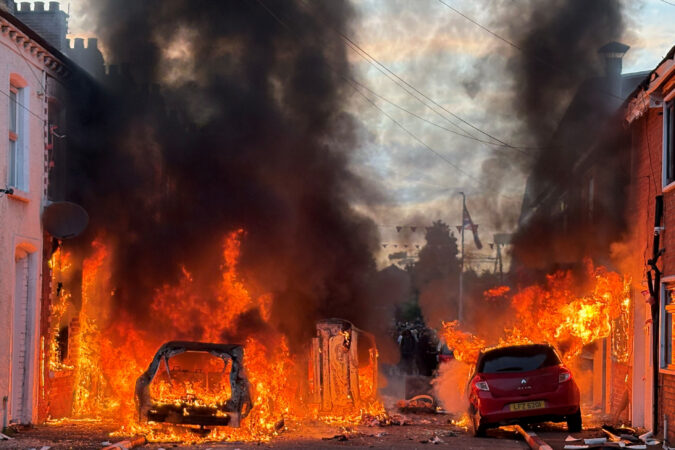
Riots recently erupted in Northern Ireland in the aftermath of an attempted beheading, when a Sudanese immigrant attacked an Irishman with a knife. Thing had already been tense in the UK because of another travesty, where eighteen-year-old Henry Nowak had been stabbed by a Sikh immigrant. When the cops arrived, the Sikh claimed racism, naturally enough, and so the stabbing victim was handcuffed, bled out, and died. So because of this sort of thing, the levels of exasperation were high, and these riots were the result.
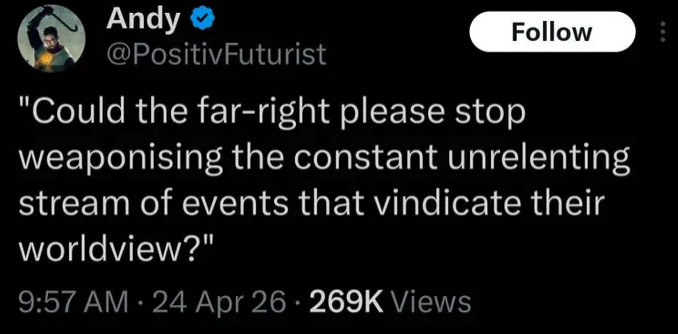
It is tempting, in a time like this, to recite various nostrums of the left right back at them. The riots in Ireland are fiery, certainly, but mostly peaceful. I mean, how many cars and buses weren’t burned? Tell me that. Or we could appeal to Martin Luther King Jr, and say that riots are the language of the unheard. But that one is actually true this time.
Now quite naturally, responsible conservatives are called upon to condemn the rioting. If I might, I would like to say some other things first. We can table the question of condemnation to the last section. Other things are actually more important, believe it or not, but we will still get there.
Actions, Not Arguments
In the ongoing saga of our societal collapse, we have gotten to the point where more talk will be absolutely useless. A meme-worthy observation is making the rounds in conservative circles, and it is well worth repeating again here.
“It’s amazing how much leftist discourse is just them pretending not to understand things, thus making discourse impossible.”
The one thing that riots have going for them is that it is very difficult to pretend to not understand them. A riot is direct action, and it is certainly true that what is needed is direct action—not more verbal sparring and fencing. But while direct action is the need of the hour, not every form of direct action is the need of the hour.
I have become known as one of those conservatives who keeps saying things like “don’t take the bait,” and so some might wonder if I think that any form of direct action is taking the bait. No, it is not, and stay with me for a moment. But burning buses, cars, and various people’s homes because you are angry at the government is most certainly taking the bait. But I am now verging on condemning the riots, and I said that I wouldn’t do that just yet.
If the time for persuasion, campaigning, and elections is passing by, and the time for more direct action has arrived, what kind of direct action do I have in mind? Let me tell you.
Irish Solidarity
The thing that set off these riots was the image of an immigrant sitting on top of a citizen, trying to cut his head off. That was the initial outrage. The second stage of the outrage was the spectacle of oblivious government officials sticking with their “diversity-is-our-strength” nonsense. This is a fallen world, and there have always been appalling crimes. But what has gone well past the utter frozen limit is the apparent fecklessness of the authorities in the face of such appalling crimes. Presented with the “news story” of this attempted murder, they pretend to not understand it.
But the riots are counterproductive. Riots are violent, but they are not surgical or precise in their application of violence. It will consequently be the work of ten minutes for the ruling authorities to find some humanitarian outrage or other, perpetrated by some of the rioters, something every bit as appalling as the attempted beheading was, and display that outrage prominently. They have the media in the tank, and they can discredit everything the protesters are trying to say.
What then? The Irish—and the Brits also—need to take a page from the early eighties, and follow in the footsteps of Lech Wałęsa and the Solidarity movement in Poland. It is time for a general strike. The people of the UK are being governed by blinkered tyrannical rulers, but they remain rulers who are entirely dependent upon the acceptance of the people—and non-acceptance can be communicated in various ways. Elections used to be the standard way to communicate non-acceptance, but as numerous elections in recent years have demonstrated, that process has been effectively corrupted. Riots also communicate non-acceptance, but in a way that is spastic and uncoordinated, and liable to answer outrages with more outrages. And who needs additional outrages? But a general strike is different. If I might mix a metaphor here, you don’t need to burn any buses in order to stand on their oxygen hose.
When riots explode, they have the understanding of many, which is not the same thing as having the respect of all. When Solidarity took their stand, they had the respect of the world. They were right up there with Tienanmen Square tank man.
But how? What is needed is leadership, but it has to be the kind of leadership that is willing to take a risk. Lech Wałęsa was an electrician in a shipyard, and he stepped out in front of the movement to make himself an identifiable target. The organizer of a general strike will be identified as such. Everybody will know his name. Rioters usually have the privilege of anonymity—darkness, numbers, masks, confusion. The person who provides an actual rallying point for effective direct action will be taking an enormous personal risk, a risk that would require cold courage. And cold courage is a lot harder to find in this world than hot anger.
It might be someone who is already known, or it might be an Irish Lech Wałęsa. It could be a member or Parliament, or the mayor of a city, or someone like Conor McGregor. It might also be someone who becomes a famous name precisely because he stepped into the arena and said what needed to be said. And what he would say would be something like, “No need to burn anything down. We will need all these things after we have taken our country back, after we have fixed our problem—that problem being those people who, in the name of governing us, are actually destroying us.”
Anarcho/Tyranny
What we are dealing with today in the West is a form of anarcho/tyranny. This is a diseased form of managerial government which seeks to combine anarchy for the lawless and tyranny for the law-abiding. So far they have been pretty successful at it. Wrist slaps for the lawless, and stringent punishments for those want to play by the rules. Mugging is tolerated and self-defense against muggers is not.
The system of anarcho/tyranny begins by being slack with native criminals, and harsh with those who resist them. A homeowner who defends his property against a burglar can get in far more trouble than the burglars do. In the UK, you can get in more trouble for posting a meme about violent immigrants than you can for being a violent immigrant. And it all begins with a “soft on crime” mentality, which is hard on anyone who does not join in with the soft on crime approach.
Anarcho/tyranny is then taken to the next level with unrestricted immigration. You not only let in the Third World, but you also let in Third World levels of criminality. At a certain point, the law-abiding explode, and nine times out of ten this just strengthens the hand of the anarcho/tyrants. They say, “white privilege now includes burning Belfast down, and so we clearly need to take steps and implement measures.”
Insightful People Saw It All Coming
Among the many prescient things that he wrote, C.S. Lewis once predicted the kind of thing that would contribute to the rise of a vigilante approach to justice. He thought that this would be a terrible thing, but it was also the case that he understood how it would come to pass. His essay was called Delinquents in the Snow, and I discussed that essay at some length a few years ago . . . you can check that out here. I commend the full essay to you, and it can be found in God in the Dock.
“For those who suffer are chiefly the provident, the resolute, the men who want to work, who have built up, in the face of implacable discouragement, some sort of life worth preserving and wish to preserve it . . . They are, in fact, the bearers of what little moral, intellectual, or economic vitality remains. They are not nonentities. There is a point at which their patience will snap.”
C.S. Lewis, “Delinquents in the Snow”
Lewis wrote this because he was responding to a lady judge who was being stupidly lenient, treating property crimes as childish pranks.
The judge, “if she read this article, would say I was ‘threatening’—linguistic nicety not being much in her line. If by a threat you mean (but then you don’t know much English) the conjectural prediction of a highly undesirable event, then I threaten. But if by the word threat you imply that I wish for such a result or would willingly contribute to it, then you are wrong.”
Ibid
That Promised Condemnation?
I am certainly willing to condemn the riots, but we need to begin by condemning the entire process that produced them. We need to start with those who fomented the riots. And I don’t mean the person who threw the first brick, or set the first fire. I mean the people who refused to understand that you cannot import massive numbers of people steeped in an alien way of life and not have this kind of explosion. I mean the architects of Irish Inclusivity.
I also am willing to condemn those in power who will use the riots that they fomented as clear evidence that they should stay the course, and foment many more of them. This is a technique that can work a lot longer than you would think it might. Those who are governing us are not very good at governing us, but they are very good at staying in power despite being so very bad at their real job. Look at the mayoral race in LA. This is because they work very hard at what they think is their central job, which is staying in power.
Blind furious reactions to this hubris of theirs is the kind of thing that plays right into their hands and so, sure, I condemn it. I condemn it heartily.
“We may be sure that, if a Ku Klux Klan arose, its ranks would soon be chiefly filled by the same sort of hooligans who provoked it.”
C.S. Lewis, “Delinquents in the Snow”
Understanding riots is not the same thing as approving of them.
So conservative Christian believers have no business in participating in anything of the kind. If I found out that some of my parishioners had been out the previous week smashing windows and setting fire to random objects, they would be placed under church discipline. Really. Professing Christians don’t get to behave like that. Everything about that would be no bueno. It is sinful, it is criminal, and it is stupid.
But participating in a general strike . . . that would be a different matter. In fact, I would hope that they would be in key leadership positions.