

Introduction

I have already raised the central concern that we should have concerning AI, which is the problem that I have identified as AI-dolatry. AI excels at role-playing and has no scruples about role-playing as the Most High God. That being the case, and given the fact that the human heart is a factory of idols, as Calvin put it, there are plenty of people around who would be willing and eager to go along with such a charade. I mean, if there are thousands of people out there who are emotionally attached to their cyber-buddy, and who have to go through a grieving process when the system upgrades, then what is to keep them from getting religiously dependent on the holy-ghost-in-the-machine? And as Glenn Reynolds argues in his recent (very good) booklet, Seductive AI, we must remember that people are not all that hard to gull.
So I expect we are going to see some massive dislocations there, meaning in the realm of worship and devotion. So that is going to happen, and we should be preparing to man the barricades on that front. We do that by gathering with God’s people, on the Lord’s Day, in order to sing the psalms, hear the Word, and partake of the bread and wine. But there are some other downstream issues . . .
Much of the Worry . . .
When professional worriers express their concerns about the impact of AI, it is often the economic side of things that comes to the fore. As mentioned above, I don’t think that is the main thing, but it is a thing, and so we should address it.
It may look like I am changing the subject, but I am not, promise. This is not a lurch. One of the reasons for black/white hostility in the South back in the day was because the poor whites and the poor blacks were competing for the same jobs. They all had limited options, and somebody else, also with limited options, was reaching for the same thing. Competition is often fiercest in the middle, or at the bottom, and not in the upper echelons. At this point, I have to raise my fedora in a little hat tip for the extended Wilson family dinner discussion we just had. There, footnoted. Sorry, this is not quite accurate. We did have an informative discussion, but I don’t really have a fedora.
There is an old joke about campus politics . . . the reason the battles there are so fierce is that the stakes are so low. But the ostensible stakes—the parking on campus, or who will chair what committee, and so on—are not the actual stakes. The vast majority of the great middle will live and die in the middle. Very very few, reach escape velocity. And so the battles over promotions and what not are not because that particular promotion is the ultimate issue. Rather, all of that is positioning. People are looking, constantly looking, for their one ticket out of there. But getting out is like winning the lottery. It happens, but a lot less frequently than you think . . . but still enough to keep people buying the tickets.
If competition in the mediocracy is already fierce, given the nature of the case, and AI can outperform mediocre workers, the people who were looking to AI to cut corners for them will come into work one day only to find out that their boss has cut all the corners for them, and they discover that they have been replaced by kiosks.
In other words, if competition among the mediocre was already hot, and if machines can do the job better than that, and the machines weren’t demanding minimum wage, then the floors of the fast food joints are going to be pretty bloody. And when the downsizing kicks in for real, it will be the middle and the bottom that are radically affected. In principle, what jobs could be replaced by AI? It won’t just be in the fast food joints—we should think of long haul truck driving, bureaucratic functionaries, mid-tier academics, screenplays written by midwits, and so on.
In using terms like mediocre, or middle, or bottom, I am not abandoning the Reformation doctrine of the dignity of all vocations. Take care to read through the conclusion below.
What AI Cannot Change
AI has significant reach, but it does not have infinite reach. It can touch many things, improving some and wrecking others. But one of the things that it will not change—trans-humanists notwithstanding—is human nature.
“The thing that hath been, it is that which shall be; and that which is done is that which shall be done: and there is no new thing under the sun.”Ecclesiastes 1:9 (KJV)
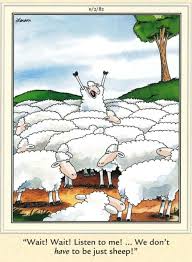
I mean, look at us. The year was 2020, not that long ago, and we had computers, and indoor plumbing, and rocket ships, and kidney transplants, and satellite television, and a bunch of other stuff just like that, and yet in the COVID scare we acted like a bunch of unwashed medieval peasants from a Monty Python skit. I believe the phrase is “moral panic”—a widespread and disproportionate case of the doodahs, shared by hundreds of thousands. Some people are still wearing masks. All the tech surrounding us did not transform us out of our Dufflepudedness.
The spectacle could produce startling juxtapositions. I recall flying through Salt Lake City in the midst of the panic, and this was also at a time when the airport was undergoing a massive expansion. I recall marveling at the levels of human ingenuity that went into that gargantuan construction project outside the windows, and it was all happening right next to the high levels of galloping stupidity inside the windows.
Now one of the characteristics of this ineradicable human nature is that the bell curve is always going to be with us. And if you are wondering whether I have wandered off of my AI point, I reply, somewhat tersely, “Hold your baby horses. I’ll get there.”
One of the constants is that cream rises. Skill matters. Industry matters. Hustle matters. Genius matters.
By the same token, and in an inverse way, mediocrity matters. Laziness matters. Lethargy matters. Stupidity matters. Read the book of Proverbs again.
When handed a tool like AI, one kind of person will see in it an opportunity to cut more corners than he was already cutting, while another person will see in it an opportunity to multiply his fruitfulness by 10x. The former will see in it less work, while the latter will embrace it as a means of cultivating more work. And the former vastly outnumber the latter.
“Do you see a man who excels in his work? He will stand before kings; He will not stand before unknown men.”Proverbs 22:29 (NKJV)
One of the characteristics of the mediocre middle is that they want to persevere with the task of mediocre inputs, while at the same time hoping for stellar outputs. But in order for this to happen, lightning has to strike. One must win the lottery. There must come a remarkable event. The sad thing is that many of these people believe that the advent of AI is that remarkable event, and that it has come for them. And so it has, but not in the way they think. AI will wipe out the middle first.
Some will do very well in the midst of all this chaos, and “very well” is almost certainly an understatement. And what this demonstrates is that the more things change, the more they stay the same.
Honoring Honest Work
I am anxious that my use of the word mediocre not be taken as some sort of a slam or sneer directed at simple work, at honest work. Not a bit of it. One of the great doctrines recovered in the Reformation was the dignity, under Christ, of all honest, lawful work. Mediocre work is what you get when simple work is flattered instead of honored, and where a sense of entitlement creeps in.
Elon wants to address the inevitable dislocations that I am talking about by guaranteeing everyone a set income. He believes the coming economic revolution is going to usher in an era of great prosperity and abundance, where people won’t have to work to stay alive. And even if they wanted to work, there will nothing meaningful that they could contribute. And there we will all be, as happy as so many hogs lined up in the sty.
I just used the word happy, but that’s not quite it. The word I was looking for was unhappy. God created man for meaningful work. The fourth commandment has two halves. We are all familiar with the requirement that we take a day of rest before the Lord. But the other half of the commandment requires us to work for six.
And if you have just taken away a man’s reason for living, it will hardly answer to just give him a “living.” Another Monday, and once he has cashed his “thanks-for-breathing” check, he can walk down to the pharmacy to renew his orgasm pills, as he was almost out, stroll over to the library to have a summary of Brave New World downloaded into his brain, and then go home to stare at the ceiling.
The only possible response to any such nightmare is a religious commitment to the obligation of meaningful work. This can only be sustained by orthodox worship in a vibrant community of real people making real things. Economic arguments as a foundation for meaningful work are already teetering. We need religious commitments to undergird our work, not to mention religious commitments that sustain the economic arguments that we used to believe could sustain themselves.
One good place to begin would be with David Bahnsen’s book Full Time.