

Introduction
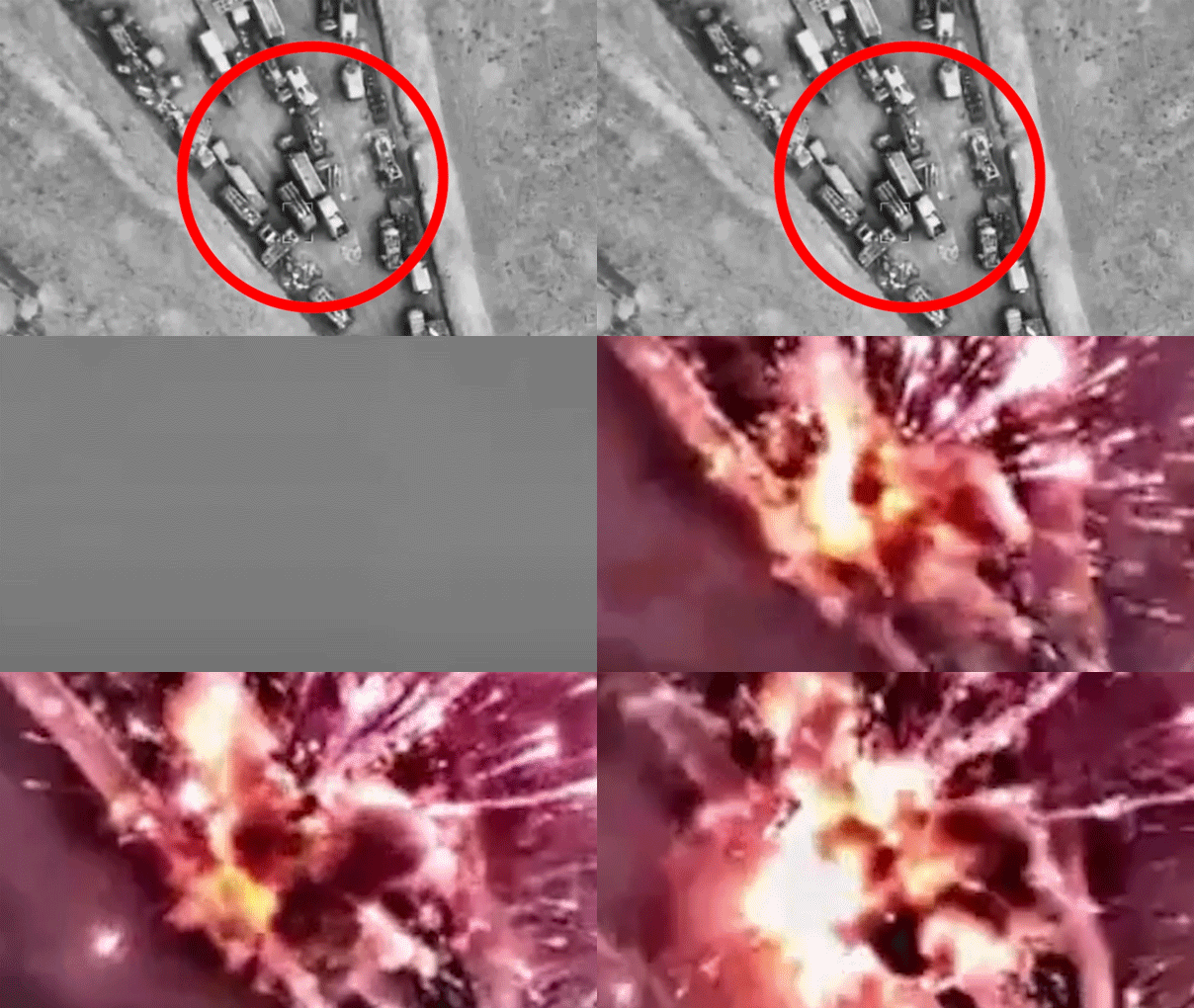
So the war in Iran has been going on for a little over a month now, and enough of it has unfolded that I am now being asked on the regular what I think of the big picture. This post this morning would be my attempt to answer that question. As a reminder, these preliminary thoughts are what I wrote right after the fighting started.
Just War Theory
When Christians come to evaluate war, any war, it is genuinely foolish to begin the reasoning from scratch. The church has been in this violent world for two thousand years now, and that time has spanned countless wars. We have had quite long enough to figure out what we make of it all. And in the course of these very human events, we have hammered out what is known as “just war theory,” and in my mind, that is obviously the best place to start.
As a summary, here is something I wrote in opposition to the war in Iraq.
“Over the centuries, Christian theologians (beginning notably with Augustine) have developed criteria under which war may be undertaken. There are two basic categories. First is jus ad bellum—the circumstances under which it is appropriate to go to war, and jus in bello, the standards of conduct within war itself. For the most part, with certain notable exceptions I believe our military does well in fighting in a way that lines up with jus in bello (e.g. not executing prisoners, not attacking civilians as a principal target, etc.). But on the criteria for war ad bellum, we have it all gummed up. Such standards include 1. having a just cause, 2. an appropriate authority declaring the war, 3. having a righteous intention, 4. having a reasonable chance of success, and 5. having proportionality between the end sought and the means used.”
A Just War?—a piece I wrote back in the day, opposing the war in Iraq
So what about this war? I will reserve the jus in bello question to the last section of this post, the one that deals with Pete Hegseth and the CREC.
When it comes to the other category, the jus ad bellum criteria having to do with whether we have any business doing this at all, I would give us different grades in different areas, and in what follows I am going to break it out differently for Israel and the United States. I am going to give you my take for each on a scale from 1 to 10. 1 would mean “absolutely not” and 10 implies the question of why it wasn’t done years ago.
Just cause: Israel has all the justification she needs to be at war with Iran. Iran has been conducting a proxy war on Israel through Hamas and Hezbollah for years (10). Iran has been behind the deaths of many Americans (as has been pointed out many times by advocates of this war), but many of these deaths were soldiers in active war zones over there. So our claim here is strong, but not as strong as Israel’s (7). Israel’s homeland has been under constant attack for years, while much of the violence aimed at us has been in response to various military actions of ours (saying nothing here about whether those actions were justified). Iran was behind many American fatalities in Iraq, for example, but these were battlefield deaths, and what happens in a war cannot be the cause for going to war. But if we had gone to war with Iran when the embassy hostages were first taken in 1979, we would have been at a (10). We should also want to budget for the possibility that there could well be some behind-the-scenes reasons for the war—of a geo-political nature—having to do with Russia and China and the oil that maintains them, where all the facts are not publicly known, and which could possibly raise the evaluation higher than a (7). For more on that kind of thing, see below.
Launched by an appropriate authority: According to the Israeli system, the government of Netanyahu (not Nethanyahu alone, but the prime minister together with his Security Cabinet) has the authority to undertake a military action like this (10). The Knesset does not need to authorize it beforehand, although they clearly could have influence through the budget or something like a vote of no confidence if the war were going badly. For the United States, the War Powers Resolution of 1973 authorizes the president to launch military attacks like this, but places various limitations on it. Congress must be notified within 48 hours, and the deployment is limited to 60 days, plus allowing another 30 days for withdrawal. The military action would then have to cease unless Congress declared war, or if they authorized continued hostilities through statute. The former would be constitutionally legit, and in my view, the latter not so much. Now with that said, this arrangement has been the way Washington conducts its war business for over half a century now, and so according to the established way our government now works, this war was launched by an appropriate authority (10). But if we were going by what I understand our original constitutional system to have been, it would have been more like a (3). But we don’t live there any more, and the Trump administration is playing by the rules that are currently extant. I consider it a de facto arrangement, and so we come in at an (8).
Having a righteous intention: For both Israel and the United States, having an Iran that was incapable of developing nukes constitutes a righteous intention (10). It should be noted, however, that I remember being constantly told over the course of many years that the Iranians were just “weeks away” from having nukes, so cum grano salis is appropriate here. But they did in fact have a nuclear program, and however close they were to nukes, they are a lot farther away from them now. I quite agree with the president that an Iran with nukes was a genuine no bueno.
A reasonable chance of success: Both Israel and the United States had reasonable grounds for believing that the air campaign could succeed in achieving their declared aims for the war (10). But if we get suckered into committing regular ground troops there, I would take that number down to (5). I am exempting from this calculus any the special forces who were on the ground rescuing the pilots, for example, or any limited operation by commandos taking a place like Kharg Island. However, if we were to undertake any kind of disastrous nation-building venture, like we tried in Iraq and Afghanistan, that would take the likelihood of success down to a (2).
Proportionality between end sought and means used: to date, both Israel and the United States have been targeting Iranian leadership and military facilities in a way that is consistent with this principle (9). However, if some of the president’s rhetoric were to be taken literally and then also implemented, that would be what just war theoreticians would call a (-2). But more on the president’s rhetoric in the next segment, in a section all its own.
When the President Says He Wants to Make the Rubble Bounce
When the first draft of this article was written, the Tuesday night deadline had not yet arrived. If the Strait of Hormuz was not opened by that point, the president had said, we would rain down red, white, and blue ruin on targets hitherto untouched—critical infrastructure, in other words. But just before that deadline hit, Iran and the United States agreed to a two-week cease-fire. And it looks for all the world as though Iran blinked.
A side note here. For those in the grip of Trump Derangement Syndrome, Trump is the one who blinked. For example, Bill Kristol called this one the mother of all TACOs (Trump Always Chickens Out). Skidding from one side of the road to the other, these critics can never seem to make up their minds. One minute Trump is a genocidal lunatic, enthusiastically ushering in WW3, at which point all of us will die. The next minute, Trump is a blustering but lily-livered coward who never follows through on what he says. But wisdom is vindicated by her children.
So Iran blinked. Good news, people! The baby that Solomon threatened to cut in two doesn’t actually have to die.
President Trump presents us with a really interesting problem when it comes to the interpretation of his rhetoric. My conclusion is that it would be wise to take him seriously, but never wise to take him literally. I remember how after the Venezuela operation Marco Rubio made a point of saying that we had a president who means what he says and says what he means. That is not exactly accurate, but there is an important element of truth in it.
Standard-issue presidential types certainly know how to talk tough when it comes to Iran. But then, after the fact, absolutely nothing happens. Trump talks tough also, but when he does that, he follows it up with some remarkable thing, but it is frequently an action different than what he said he was going to do. So, like I said above, he needs to be taken seriously, not literally. You don’t know which way the football is going to bounce. Let’s change sports, shall we? He is a big league pitcher who only knows how to throw screwballs. The commies and the panicans are derisive when it comes to his wind up and form, but then they have to quietly ignore all the batters he manages to strike out. He makes them all look like an old lady trying to hit a bee with a broom handle.
It is all art-of-the-deal stuff. He is not sitting up late trying to figure out what the maniacs in Tehran are going to do. He wants them to be sitting up late trying to figure out what the maniac in Washington is going to do.
And, thank the Lord, it worked. Again.
Pete Hegseth and the CREC
There is an additional factor in all of this in bello discussion. Pete Hegseth, the Secretary of War, worships as part of our church service in Washington D.C. How does that factor into all of this?
Outside critics of the CREC are in a cleft stick about this. On the one hand, some critics want us to intervene and “make Pete stop it.” But then, think for a minute. Do these same critics really want me or any of my fellow pastors—with no background on the intel, with no military training at this level, with no security clearance, and with no basis for sticking our noses into the internal workings of the Pentagon—to be giving Pete any specific policy advice? That would be what keen observers would call way out of line.
But wait a minute. Perhaps some of you noticed that I am at the tail end of a long article that is filled with observations and comments about the war. Isn’t that a contradiction? No, it is not, not at all. My knowledge of the war is basically what any reasonably informed citizen can gather about the war from news that is publicly available. And by “the news,” I mean all the variegated sources we have now, as opposed to the monolithic media we had when I was a kid. I take in this information and evaluate it in the light of a biblical worldview, in which I seek to apply ancient biblical principles to modern conditions. For example, the ancient Israelites were commanded, when they besieged a city, to leave the fruit trees alone (Dt. 20:19-20). I would extract from this the jus in bello principle of not blowing up Iranian infrastructure that a large civilian populace was dependent upon. All of this functions in the realm of public commentary.
If anyone in the administration reads it, and finds any part of it informative, great. It is a free country. But my position as a pastor in the CREC does not give me any right of access to all the ad bellum considerations that Pete Hegseth has access to, and the responsibility for. He has a responsibility to love God, study the Scriptures, learn the wisdom of the Christian tradition, and then to do what he believes to be the right thing. On the basis of the publicly available information, we either trust him or we don’t. The same thing goes for his elders and pastors. We either trust him or we don’t. It should be obvious that I do.
Because ordinary soldiers and sailors are responsible to stay within biblical bounds when it comes to in bello questions, it is not out of line for ordinary citizens to develop their convictions in the light of various in bello considerations as well. We come to our conclusions, and we vote accordingly.
But ad bellum is a different matter, and please note that a lot of the purported in bello outrage by opponents of the war is actually being shaped and driven by hidden ad bellum assumptions, with those assumptions being built up on a large flat concrete slab of ignorance.
C.S. Lewis is very much in the mainstream of the Christian tradition when he says this:
“It must be absurd to give to the private citizen the same right and duty of deciding the justice of a given war which rests on governments; and I submit that the rules for determining what wars are just were originally rules for the guidance of princes, not subjects”
C.S. Lewis, God in the Dock, p. 326
And so all of this is why I would urge all believing Christians to mark out their lane, to stay in it, and to pray for Pete Hegseth as a brother. If on the basis of the information they have put together concerning the war, they differ with the decisions that are being made, or with what I have argued above, that is totally legit and in bounds. We all want to be responsible citizens, and so we do what we can with the information we have. Responsible debate is a good thing.
But if they are like some cyber-solons I could name, who have one one hundredth of the information that Hegseth has, but who mysteriously have ten times the wisdom, and who set up their jitney courts in order to accuse him of war crimes, the results of that kind of hubris are a strange mixture of sad, macabre, utterly conceited, and funny.