

Introduction
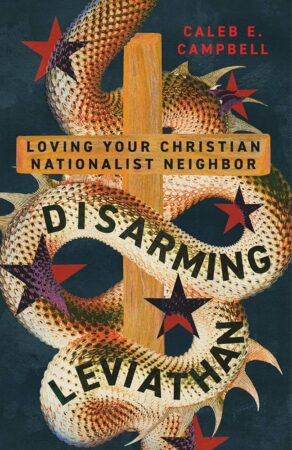
Okay, so we are now going to take on pp. 152-159—we had previously been going through Disarming Leviathan, and we were doing good, but then November and all of its associated highjinks got in the way. Now we are back, and back at it.
In this section, we are going to discover that Caleb Campbell does not really object to Christian nationalism at all, not even a little bit. What he objects to is right wing Christian nationalism.
This is hard to see at first. The initial impression is that he is simply contradicting himself—trying to suck and blow at the same time. And, okay, truth be told, there is some of that. But there is also quite a bit of cheer-leading for Christians who want to bring Christian values to bear on society at large. That would be quite all right with him, provided these Christian values protect the voices of those on the margins. And by marginal voices, he would not mean editorial observations found in neo-Confederate newsletters. He would mean a different sort of marginal.
Applauding the General Concept
In a “wouldn’t-it-be-nice” sort of way, Campbell approves of those who want to bring their Christian faith to bear when it comes to politics. That should be understood as a good and honorable thing. It should be affirmed as you are trying to reach out to your Christian nationalist neighbor.
“In our conversations, we can honor the fact that those in our mission field want to apply their faith to their politics.”
Disarming Leviathan, p. 152
And in his first coaching tip, he provides reinforcement to this point.
“In conversations with our mission field we want to do three things. First, affirm the desire for people in our country to love, follow, and live like Jesus and for our culture and laws to be just and virtuous”
Okay, so that would be a good thing. Were it to happen, that would be good. Who could object to just and virtuous laws? What could be wrong with the people of our country coming to love, follow, and live like Jesus? Were it to happen, he would be for that. But then a cautionary note comes in.
“Second, we want to invite our hearers to consider the best way for Christians to influence the government and. the broader culture. Throughout Scripture and church history this is accomplished through self-sacrificial love and service to others, especially to those on the margins.”
DL, 152
Notice here that he emphasizes that this goal needs to be pursued in a particular way. We need to “consider the best way” that we might influence the government and the broader culture. He seems to indicate that this is at least a possibility when he acknowledges that “this is accomplished through self-sacrificial love and service to others” (emphasis mine). He states that this is the case throughout Scripture and throughout church history. This seems fairly optimistic, but hold onto that thought because he is going to scratch it all out in a minute.
But in the meantime, he is not opposed to America adopting certain Christian values.
“I would love America’s laws and culture to be shaped by the Christian values of love, grace, humility, justice and truth.”
DL, 153
Ah. And so here we come to the nub. How do we define “love, grace, humility, justice and truth?” And what about other Christian values, like “courage, steadfastness, orthodoxy, and hatred of evil?” Just above he had mentioned “self-sacrificial love and service to others,” what might be called the happy Christian values. The contra-mundum Christian values are not really in view.
So here would be a simple question for Campbell. Was Charlie Kirk an example of self-sacrificial love? Did he embody love, grace, humility, justice and truth?
Given the fact that earlier in his book Turning Point USA was Campbell’s foil for everything he is critiquing, the answer would clearly be no. Charlie Kirk is not the model he would want us to follow—however kind he was, and however much he sacrificed.
So before we go out there, resolved to be loving, gracious, humble, etc. we must turn to the Scriptures in order to define love, grace, humility, and so on. But this is not a task that Campbell undertakes, not at all. He simply assumes certain soft values as virtuous, and then summons Christians to live up to those values, simply because some of those same words are found in the Bible.
For example, in one world, you love a sexually confused teen by affirming his current dysphoria, and pledging your support for whatever irrevocable damage he might want to do to himself. In another world, you would love that same teen by telling him the truth, which is that he is not a girl and never has been. In both cases, the word love is used, but the definitions are as far apart as Heaven and Hell. It is clearly not enough for us to wave our hands over certain virtue words. We have to ask what those words are representing.
Love is not to be defined by a consensus of the wine moms of Martha’s Vineyard. Love is to hate every false way (Ps. 119: 104, 128). Love is to treat others lawfully from the heart (Rom. 13: 8-10).
Sadly, Such Influence Cannot Happen Now
But before anybody gets their hopes up, none of this is going to happen anyway. Even though Campbell has said that “throughout Scripture and church history” governmental and cultural influence is “accomplished” by self-sacrificial love and service, that is apparently not in the cards for us.
“Last, we want to discern if establishing a Christian nation is something the Scriptures call for or is even possible. Just because many Christians serve in government does not make the government’s actions inherently Christian”
DL, 153
Now if the Scriptures don’t call for it, why even try? If it is not a possibility, then what’s the point? He says here that getting a lot of Christians into government doesn’t necessarily do anything, which is true enough. Everything rides on whether or not they act like Christians when they get there. At the same time, he has also said that self-sacrificial love and service do “influence” government and culture. They do accomplish something, but apparently not all that much. If they accomplished much of anything, then apparently it is possible, and perhaps the Scriptures do call for it.
Where does this leave us? The only way to make this consistent for Campbell is by adopting the marching creed of Ameliorism. Government is bad but we, through the dint of unstinting self-sacrificial love and service might influence it to be a little less bad. Culture is rotten but if we as Christians hearken to the voices on the margins, we might make it a little bit less rotten.
“I’ve been wondering what is the best method for cultivating Jesus-centered change in society. I’ve been reading the Bible lately and can’t find anything that argues for a top-down take-over-the-institutions approach”
DL, 159
This raises two points. First, how much Jesus-centered change is even possible in a society? Is it possible to have noticeable change? Without getting to a full-tilt Christian nation, might we make it 30% better, as opposed to .003% better? That would be one question. If the former, then why is a Christian nation not possible? Couldn’t we keep on going? And if the latter, then why bother? We wouldn’t ever be able to tell if we were accomplishing anything at all.
The second thing is his jab at the “top-down” approach. Is he opposed to the king being persuaded by any of this? What if a magistrate is awed by all the self-sacrificial love and service he sees from the Christians walking the Jesus-way, and he is converted, and then he asks, “what am I supposed to do about this slave trade business?” Suppose Campbell is part of the delegation the king summons to address the question. Does Campbell say something like, “In the first place, we need to avoid a top-down approach?” If so, why? If not, why not?
“Lately, I’ve been thinking about the teachings of Jesus. He seems to frequently call his followers to serve others, go the extra mile, pray for their enemies, and so on. How do you think his example could shape our ideas of cultural renewal?”
DL, 157
Okay. Serve others how? Go the extra mile to what end? Pray for our enemies, check, but who should those enemies be?
Top Downery
“If the United States claims to be Christian and then does acts of violence (like waterboarding or killing civilians), I wonder how that might compromise the witness of our missionaries serving abroad.”
DL, 154
It is easy to imagine such tension arising. And we can ask the question in an even-handed way. Say that a missionary is having to explain waterboarding under Bush or lethal drone strikes under Obama. A current issue could be blowing up narco-boats. Depending on the nature of whatever it was our government was doing, it could at times compromise the witness of the missionaries. But even if defensible, it would at least complicate the witness of the missionaries. Cheerfully granted.
But if we persuaded the government to knock off the waterboarding, isn’t that a top down approach?
And here is another place where the call for repentance would need to be top down.
“I think I remember hearing somewhere that Caesar was often worshiped as a god. That is destructive to any society and especially hurts people on the margins. In what ways can we Americans (arguably one of the most economically and militarily powerful governments in the world today) guard ourselves from empire worship?”
Before getting to the meat of this one, I want to mention something as an aside. Campbell says something here that reveals that he is not really aware of the geopolitical realities at all. This can be seen in his phrase “arguably one of the most economically and militarily powerful governments in the world today.” One of the most? Economically, American cities match up against other countries. The New York metro area is on a par with the United Kingdom, the Dallas/Fort Worth area with Switzerland, and LA with South Korea or Australia. And the American military is by far and away the most powerful military in the world. Now I recognize this does not weaken Campbell’s caution about idolizing American power, but rather strengthens the warning. At the same time, it shows that he is not really abreast of the actual state of affairs.
So there is a real danger of an imperious hubris taking over. The American empire might really get above itself. And so with that said, is there a political movement today that wants the government to radically downsize? Wants to reduce the size and scope of governmental intrusion in the affairs of everyday Americans? Wants to put an end to “forever wars”? Wants the emperor to realize that he is not a god upon the earth, but rather that he must be accountable to the God of Heaven? Yes, there is. This movement is called Christian nationalism, and Caleb Campbell has written a book against it.
In addition, whenever Christians of any stripe warn the emperor about the need to reject empire worship, any such rejection, if done, would be a top down sort of thing.
Forceful Conservatives?
When conservatives organize effectively, and start making a difference, Campbell weirdly sees it in terms of some kind of violence. He says that we are promoting “sword power over cross power” (DL, 157).
To date, the culture wars have largely been waged by means of polemics and politics. There is a culture war going on, certainly, but so far it has largely been a cold war. There has been some violence, to be sure, but that has been overwhelmingly from the left. Compare the reactions to the death of George Floyd and the death of Charlie Kirk.
But Campbell describes what conservatives want to peacefully do in terms of violence, while ignoring what the left violently demands—”sword power.” It is sword power to win a school board election?
“The call to forcefully obtain positions of authority within society has various forms that include taking control of the school board, the federal government, the media, and the culture (by way of winning the culture wars).
DL, 157
I really am curious here. What does he mean by “forcefully obtain positions of authority?” What does he mean by “taking control of?” Does he mean well-organized campaigns? Does he mean winning elections? Is he talking about getting engaged in the democratic process? Registering evangelicals to vote?
Now it is the nature of government to require things. And if conservatives mobilize and win elections, then of course they will then control what the government will require. But this should not be described in terms of a scary takeover because what they will require will be less.
The left tends to define democracy in terms of the left winning elections. If they lose an election, that is always described as a “threat to democracy.” And when a conservative wins an election fair and square it is described as incipient fascism. But that is like saying if the Denver Broncos win a squeaker over the Washington Commanders, this should be considered a “threat to football.”
A more reasonable observer might say that it is football.