

Introduction
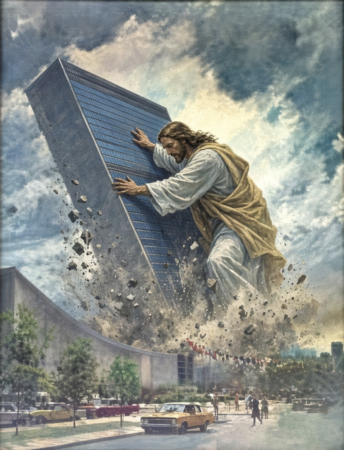
At the triennial meeting of the CREC Council a few weeks ago, we adopted a memorial on nations. This was the culmination of a process that began over three years ago, and I am very happy with the result. Just like whiskey has to be in the barrel for three years before it can be sold as whiskey, so also the truth is better when it is barrel-aged.
Below is the text of the memorial, and following that I would like to offer some observations that should help inform the sensible, although it might further inflame the already inflamed. There’s really no telling with those guys.
I do need to emphasize that it was the statement itself that was approved by Council, and not my comments on it. At the same time, I think it is fair to say that the observations I am offering really are grounded in the text of the memorial. This is an exegetical exercise, and not a matter of me projecting my own thoughts and ideas onto the memorial.
So with that said, the statement really does repay close examination.
“We believe God made all nations from one man, Adam. At Babel God scattered their rebellious unity. But God, by the cross of Christ and His Spirit poured out at Pentecost, is reuniting and reconciling the nations, drawing them into one Church, the Body of Christ. Loving family, nation, and stranger in their order, idolizing or destroying none, we repudiate nationalistic and ethnic hatred, vainglory, and persecution. We seek to unite the nations in the worship of the triune God, sanctifying all peoples, languages, and customs to His glory.”
CREC, Memorial on Nations
From One Man
We begin with the unity of the human race. When God created our first parents and placed them in the Garden, the entire human race was present there. This one man, Adam, was the covenant head of the entire human race, and all of us are his children. This means that when Adam reached for the fruit in his disobedience, the hand that took the fruit represented all hands, hands of every color, whether red, yellow, black or white.
All of us together were fashioned from one blood.
“And hath made of one blood all nations of men for to dwell on all the face of the earth, and hath determined the times before appointed, and the bounds of their habitation.”Acts 17:26 (KJV)
We are therefore one race, the human race. But influenced by the rise of evolutionary thinking in the nineteenth century, what the Bible would describe as various tribes, nations, or ethnicities began to be described as races. Given their new evolutionary framework, this made sense—different races made sense in a vast network of different species, all of them related. But Scripture teaches us differently—all of us together are cousins because we were descended from one man—and not differentiated races because we ascended from one amoeba.
Ethnic distinctions of a physical nature developed as a result of the confusion of languages, and because people grouped together on the basis of those languages. People married within their linguistic group, thus creating and reinforcing certain physical traits. The resultant cultures made marrying across cultural boundaries more challenging—because of differences of language, customs. religion, and so forth—but did not make marriages across ethnic boundaries any less fertile. We are from many different tribes, but are all one species. The only marriage restriction that all Christians must honor is the requirement to marry in the Lord (1 Cor. 7:39).
Resistance to this clear truth is currently calling itself “race realism,” but I prefer exegetical realism.
United Nations, But the Good Kind
There are two sorts of unity that are set before us in this memorial, one of them rebellious and idolatrous, and the other submissive and obedient. By confusing the languages, God scattered an early attempt at rebellious unity at Babel, the forerunner of all globalist attempts to govern the world apart from Christ. The thing that made this rebellious unity sinful was not the unity per se, but rather the fact that the unity was being built on a rebellious foundation. The problem was not the unity, but rather the fact that the unity was idolatrous and hostile to Heaven. Of course, such unity is not really a true unity at all.
The genuine unity offered in and through Christ is quite different. The memorial states that the nations are drawn into “the Church, the Body of Christ.” This is harmony between the nations, not an erasure of the nations. While we refuse to idolize the nations, we also refuse to destroy them. The nations are united in worshiping the true and triune God, and this worship has the effect of sanctifying all peoples, which is not the same thing as homogenizing all peoples, or throwing them into an undifferentiated mass. The tribes, and their languages, and their customs, are all sanctified to the glory of God. This assumes their continued existence, but it is not an existence in tension with the other tribes because by that point we are bound together in love.
The worship of the true God enables us to approach Him in spirit and in truth. This requires us to deny our ego-selves (Matt. 8:34), but not our creational-selves. We face Him in worship, all together, shoulder to shoulder. But those shoulders belong to very different nations and tribes, bound together in the unity of the Spirit. We are to worship the true God shoulder to shoulder, but those shoulders are different colors, and they have different kinds of cloth that cover them.
“And they sung a new song, saying, Thou art worthy to take the book, and to open the seals thereof: for thou wast slain, and hast redeemed us to God by thy blood out of every kindred, and tongue, and people, and nation; And hast made us unto our God kings and priests: and we shall reign on the earth.”Revelation 5:9–10 (KJV)
So the Frenchmen, and the Navajo, and the Americans, and the Maori, and the Brits, and all the others, have different assigned stations in this massive choir that is assembling. And the song we will be singing then is the song that we have been assigned to learn and practice now. And we are working on it now. That is what this memorial is about, in part.
Human history is actually just an extended choir practice. Go to a believing church. Learn your part.
Ordered Loves
The fact that our unity is found in Christ, binding us together in one Church, enables us to learn the meaning of Augustine’s ordo amoris. We are commanded to love Christ more than we love father, or mother, or son, or daughter (Matt. 10:37). This means that the same standard applies to grandfathers and great grandfathers. All Christians must love Christ more than they do their own kin.
Having said so much, loving Christ in this way enables us to love our kin far more than we ever could before. For example, a man must love Christ more than he does his wife (Luke 14:26). And if a man does this, “hating” his wife, he is thereby equipped to love his wife as Christ loved the Church and gave Himself up for her (Eph. 5: 25). If he makes her an idol, she will be loved less than if she were demoted to the second place. If Christ is first, then she receives more love in second place than she would in first.
So that is the meaning of this phrase—”Loving family, nation, and stranger in their order, idolizing or destroying none.” Our ultimate commitment to Christ does not annihilate our creational relationships. We love our families. We love our nation. We love the stranger. All of this is in accordance with the law of Christ. We must not love the stranger, and our own children, and our nation in any kind of disordered fashion. A man who loves a nameless orphan on the other side of the world more than he loves the children around his own dinner table is a man who is worse than an infidel (1 Tim. 5:8). It is perversity.
Our creational loves must be structured. They must be arranged. When they are structured properly, we do not idolize them, meaning that we do not place any of them above the position of Christ. And when they are structured properly, neither do we destroy them. We do not shower them with contempt. So we also refuse to give way to the liberal self-loathing that the progressives so much want all hetero-whites to cultivate. None of that.
The Sin Rejected
So what is the sin that we repudiate in all of this? One of the challenges we faced as we were hammering this out was a challenge created by a two-fold reality. The first thing was that we have seen, in our own circles and elsewhere, a dramatic upsurge in the kind of sin that we are seeking to address with this memorial. There really is a “there” there.
But this leads to the second thing. This kind of sin is pronounced enough and visible enough for the progressive left to have given names to the various manifestations of it. Their names would be things like racism, or misogyny, or antisemitism. But for us to use such nouns in the memorial would be to use words that are “left-coded.” When the word comes in, muddy boots and all, it is difficult to avoid tracking in a bunch of leftist worldview mud along with it. I mean, after all, if sexism as they define it is a sin, then the Bible is sinful.
But if we avoid such words in such a way as to obscure what we are actually talking about, then we are just firing our revolvers into the air. We have hammered out a memorial that denounces “bad things.”
So we condemn certain sins that are on the increase in our day, but using biblical words—hatred, vainglory, and persecution. Those characteristics, all of them from the pit of Hell, are frequently indulged while waving nationalistic flags, or while parading about with our tribalistic totems. So we put it this way. “We repudiate nationalistic and ethnic hatred, vainglory, and persecution.”
So if someone were to ask a CREC minister if he believed racism to be a sin, an appropriate response should be “how are you defining racism?” If the person says, “you know, ethnic hatred. Hating someone simply because he is black, or a Jew,” then the answer would be yes. But if the answer came back as “you know, the systemic structures that support white privilege,” then the answer would be “no, that kind of ‘racism’ is not a sin.” Why? It is not hatred, vainglory, or persecution.
We already saw earlier that we applaud the rightly ordered loves of “family, nation, and stranger” in their place. We want nothing to do with the self-loathing that heaps contempt on our parents, boomer grandparents, or ancestors, or on our culture and customs, or on our system of structured liberty. We love that which God has assigned for us to love, but we want to make sure we love these things in the way we were instructed to.
At the same time, we recognize that when we make an idol out of any of these things, one of the side effects of such sin (and is sin) is that we start to hate members of other tribes, or we vaunt ourselves over them in a patronizing way. And such disordered loves cannot defend themselves by pointing to the existence of rightly-ordered loves elsewhere. A disordered man is not justified because an entirely different man is doing it right.
An Optimistic Eschatology
Although this was not the main point of the memorial, it should at least be noted that the entire thing is supported with the floor joists of an optimistic eschatology. Our assumption is that God is taking human history in a particular direction, and that direction has in mind a unified glory of the nations of the world. “But God, by the cross of Christ and His Spirit poured out at Pentecost, is reuniting and reconciling the nations, drawing
them into one Church, the Body of Christ.”
The point is not that God is taking a representative sampling from all the nations, and then putting them into a separate entity called the Church. No . . . God is drawing all the nations into the Church.
“Surely the isles shall wait for me, and the ships of Tarshish first, to bring thy sons from far, their silver and their gold with them, unto the name of the Lord thy God, and to the Holy One of Israel, because he hath glorified thee.”Isaiah 60:9 (KJV)
“And the nations of them which are saved shall walk in the light of it: and the kings of the earth do bring their glory and honour into it.”Revelation 21:24 (KJV)
In the conviction that this is what God is already doing, we understand our assigned mission to be preaching the Word, baptizing those who believe, administering the sacrament to them, and teaching them obedience to all the words of Christ (Matt. 28: 19-20). We seek to do what we believe God is in the process of doing. We seek to be the designated instrument of what He accomplishes, empowered by the Spirit.
“We seek to unite the nations in the worship of the triune God, sanctifying all peoples, languages, and customs to His glory.”
But sanctifying all peoples, languages and customs is one thing. Remember that the verb should not be confused with erasing, or blurring, or smudging, or homogenizing, or denying, or eliminating. The French are made holy, and in the process they become more French. The Chinese are sanctified, and as a result they are more Chinese than they ever were before. The Americans are instructed in godliness, and do not thereby cease to be American.
And one of the glorious things we discover through this process is that when the French are made more French they have a easier time getting along with Americanized Americans than they ever did before.
So the Church does not replace the nations. Rather it straightens them out. And that is a good thing because sin had left all of us pretty crooked.