

Good Friday 2026
When the Lord Jesus was raised from the dead, that was the moment when His triumph over death was fully manifested. The battle was over and done, and His resurrection was the triumphal parade, a procession that culminated with His ascension into glory. He then approached the Ancient of Days, and was granted a universal and glorious dominion. But all of this was the aftermath of His victory.
The agonistic victory itself was accomplished on the cross. When the Lord cried out, “It is finished,” it was that moment when death received its death blow.
“Forasmuch then as the children are partakers of flesh and blood, he also himself likewise took part of the same; that through death he might destroy him that had the power of death, that is, the devil.”Hebrews 2:14 (KJV)
The power of death was destroyed, we are told, when Jesus died.
The principalities and powers were taken out of commission when they were nailed to the cross (Col. 2:14-15). The Lord openly triumphed over them in the resurrection, but the moment of triumph proper was when death died, and death died when Jesus died.
And Jesus went to this moment knowing that it was to be the decisive point.
“Now is the judgment of this world: now shall the prince of this world be cast out. And I, if I be lifted up from the earth, will draw all men unto me.”John 12:31–32 (KJV)
This was the judgment— “of judgment, because the prince of this world is judged” (John 16:11). Judged where? Judged how? The devil was judged in the last rasping breath that Jesus gave. But the reason that death rattle was so unearthly was because the death of Jesus was not simply the end of one man’s life. It was the death of a thick cosmic shroud of despair that laid heavily on our fallen world—an aching world that was lying prostrate under the power of the evil one (1 John 5:19).
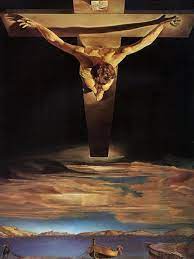
As the incarnate Son of God, the Lord was able to encompass all things when He stretched out His arms in death. Those arms were nailed to the cross, but when He died, in a figure He pulled His arms free and embraced . . . what? His arms closed on the law that was against us, on your sins, and on mine, on all our love for death and folly, and on the devil together with his accusations. And so He sank down into the grave with His arms full of all of our discontents.
He did it this way because in order for these things to die and remain dead forever, they all had to be escorted down to the depths personally. In His death, He took them all away.
“As far as the east is from the west, so far hath he removed our transgressions from us.”Psalm 103:12 (KJV)
“He will turn again, he will have compassion upon us; He will subdue our iniquities; And thou wilt cast all their sins into the depths of the sea.”Micah 7:19 (KJV)
And so the resurrection functions as the proof that death has actually died. The resurrection is not the death of death—that happened on the cross.
So Good Friday services are not funeral services. In these services we are standing on the battlefield, with wrack and ruin all around us, and death itself lies prostrate across that field. Our champion, the Lord Jesus, has done this great thing. This is the victorious battlefield. This is where we have seen marvelous things.
“O sing unto the Lord a new song; For he hath done marvellous things: His right hand, and his holy arm, hath gotten him the victory. The Lord hath made known his salvation: His righteousness hath he openly shewed in the sight of the heathen.”Psalm 98:1–2 (KJV)
This is why our Eucharistic celebrations, conducted weekly, are celebrations of this event. The cup of the new covenant is the cup of His blood. The bread of life is the bread of His broken body. We can do this because the shed blood and broken body are emblems of victory. We commemorate and proclaim that death on our weekly Easter, on the Lord’s Day (1 Cor. 11:26). We can do this because our eruption of praise on the first day of the week is a celebration of what happened three days before on a bloody cross.
For that is when death gasped and was finally gone. And so what exactly does that mean?
God told Adam not to eat the fruit of the tree in the midst of the garden. The day you eat of it you shall surely die (Gen. 2:17). And the prophet Ezekiel told us grimly that the soul that sins shall die (Ezek. 18:4). And the apostle Paul anchored this point when he said that the wages of sin is death (Rom. 6:23). The power of death and the power of sin go together. They go together necessarily.
It follows, then, that death died when sin died, and sin died when Jesus did. The law which condemned me, the sin which polluted me, and the death which imprisoned me, and the devil who taunted me through the bars . . . all of them slain, nailed to the cross.
“The sting of death is sin; and the strength of sin is the law. But thanks be to God, which giveth us the victory through our Lord Jesus Christ”1 Corinthians 15:56–57 (KJV)
In the name of the Father, Son, and Holy Spirit, amen.