

Introduction
Last week I had the privilege of debating Joe Heschmeyer on the subject of sola Scriptura. It was a remarkable event, very well organized, and to my surprise the thing sold out, with about two thousand people there. If you are interested, my opening statement is here. I had breakfast with Joe and some of the sponsors the morning of the debate, and we all got on quite well. So I would like to extend my thanks publicly to the Vandal Catholics. They were most hospitable, and did a great job.
This debate came in the aftermath of my comments about Virgin Mary parades, and it was gratifying to be debating Catholics who are willing to debate in a civilized fashion, and who do not get offended when they encounter a Protestant who really believes it. It was a good event. I would also want to commend two other Catholics who understood both the history and the point I was making—check out both Michael Brendan Dougherty and Peter Williams. At any rate, more of this, please.
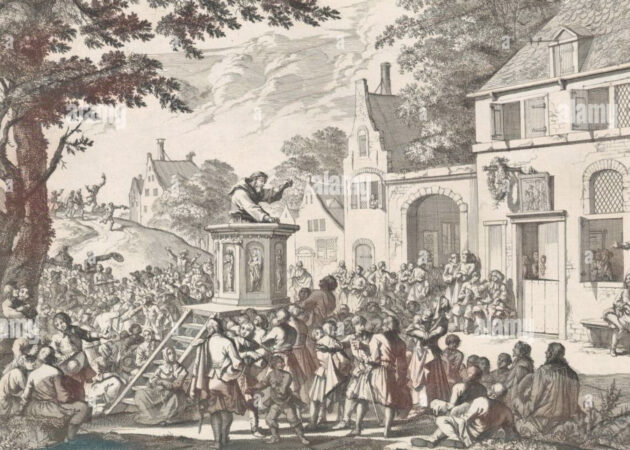
One of the things that came up in the course of the debate (naturally) was the fragmented nature of Protestantism. What good is sola Scriptura if all the people who believe in sola Scriptura can’t get their act together and agree on what the Scriptures actually say? When you look at the Protestant world all you see is Protestants differing with one another. Hey?
In the debate I replied that Protestants have only been divided among themselves for five hundred years. Rome has been divided from Eastern Orthodoxy for a thousand years. I mean, we Protestants have barely gotten started . . . give us a minute.
But there is actually a bit more to be said. Now while what follows might be a case of what the French call l’esprit de l’escalier—staircase wit, thinking of what you ought to have said while you are on the way to bed—there really is far more to be said on this subject than could really fit within the confines of a debate on sola Scriptura. It is actually a debate topic in its own right. So here goes.
Not Quite Pandemonium
The first thing to note is that the untidiness of the Protestant world is not quite as pronounced as some people assume. There is a popular idea that Protestants have tens of thousands of sects running around, and this is thought to be the direct result of an “every man for himself” approach to hermeneutics, which is a logical consequence of sola Scriptura. Joe Heschmeyer accepted my distinction between sola Scriptura (the historic Protestant view) and solo Scriptura (“just me and my Bible”), but argued that the former leads necessarily to the latter, just give it time. Not surprisingly, I don’t think so.
In my book on this subject, I summarize the 1982 findings of David Barrett in his World Christian Encyclopedia.
“So that I don’t bore the patient reader, let me just focus on the division of three of the major blocs. The Orthodox are divided up into nineteen traditions, the Roman Catholics have sixteen, and the Protestants have twenty-one. If we throw the Anglicans in, they account for another six.”
Papa Don’t Pope, p. 70
So it is not quite accurate to say that the Protestant world is in disarray, over against the stately and majestic unity of Rome. The entire Christian world is in disarray. Having said so much, I do think it would be fair to say that in the Protestant world the divisions are more pronounced, rising to the visibility of a voluntarist system. More on that as we go.
But if we only consider the mere fact of division—and how is a fellow to decide between them?—we are not dealing with a uniquely Protestant problem.
Having said this much, let us pause for a moment. How much of a problem is it really? I raise this question because unity and disunity both have their pathologies.
Church History at a Glance
Let us hope there is such a thing as a hot take on the broad sweep of church history, because I am about to try to give you one. I will not be painting with a broad brush here so much as I will be using a spray gun and five gallon bucket.
Bottom line first, and remember that I am generalizing. If we divide the church into East and West, the West has had a lot more turmoil going on, over the course of centuries. In this take, remember that Rome and Geneva are both Western. Throw everything into the pot—wars, rivalries, popes, anti-popes, more wars, Viking marauders, reformers, persecutions, and so on. There was conflict in the East also, but file a bunch of that under Byzantine palace intrigues.
My basic point is that as centuries unfolded, there was a lot more visible unity on display in the East than in the West. But over time, the unity of the East became a museum piece, behind a velvet rope, encased under the curved glass of the display window, with a couple of flies buzzing around in there. The unity of the East became sclerotic.
The disunity of the West was . . . vibrant. But I don’t intend to mislead. The vibrancy was admittedly of the hellzapoppin‘ sort.
When it came to the optics of unity, the Eastern Orthodox put on a pretty good show. But the unity of Byzantium turned out to be more or less ossified, and the disunity of the West proceeded to do marvelous things.
After the Reformation, the process continued and the West divided still more. The New World opened up, and a bunch of those divisions fanned out westward across the globe.
And Then What Happened?
So the question posed in the debate was basically this. What have Protestants ever done besides fight with each other over various doctrinal niggles? What has the doctrine of sola Scriptura done besides enable Protestants to fight about whether to baptize with heads upstream or downstream? In short, what has Protestantism ever done?
Well, to be frank, the answer is that Protestants built a very great civilization. And as a subset of that, the Protestants also built a very great nation—America.
I hasten to add that I am not saying this in violation of Paul’s admonition against party spirit—you know, “I am of Paul, I am of Apollos” (1 Cor. 3:4). I am not a chauvinist Protestant, or a jingoist Protestant, for that matter. But when it comes to Protestant culture . . . I really am a patriot.
Someone might complain that Catholics certainly had their hand in building out America, and I cheerfully grant it. But the Catholics who came here to North America have actually adapted quite well to the Protestant voluntarist system. They are not the Church of America. They are one American denomination among many. The Irish and Italians certainly flavored the stew . . . but the pot was Protestant.
The voluntarist church system is basically a free market for various religious convictions. But remember that while America was being built, the shared consensus was overwhelmingly Christian, and decidedly Protestant. Now when a system runs like that, to step into the system is to become a participant. As the saying goes, if there are twelve clowns in the circus ring, cavorting and doing their thing, you can jump down into the ring to start reciting St. Crispin’s Day speech from Henry V, but to the audience you’re just the thirteenth clown. The Vandal Catholics put on a great event last week. Well-organized, advertised effectively, brought in a well-known Catholic apologist, great job. They put up some points . . . on a Protestant scoreboard.
It is like C.S. Lewis’s Mere Christianity. At the beginning of that very fine book, he tells us that the Christian faith is a large mansion, and he just wants to get the seeker in through the front door, and into the foyer. He then reminds us that it is in the rooms—the various churches—that we will need to live, take our meals, and so on. Now some ardent Protestants are chafed that Lewis granted the Roman Catholics a room. What are they doing in here? But keep two things in mind. First, the phrase mere Christianity is a Puritan one, coming from Richard Baxter. Secondly, Lewis’s concept of the entire house is a decidedly Protestant one. A strict Roman Catholic needs to hold that Rome is the house—and not just a room in it. To accept the idea of a “mere mansion” is an enormous concession to the Protestant worldview.
Free Markets or a Free-for-All?
But in this religious free market, there are obvious limits. There needs to be a center of unity, or otherwise the society cannot cohere at all. There must be a shared center. Without a shared and defined center, the whole thing falls apart.
Compare it to the manufacture, distribution and sale of widgets. Say that we have a free market for widget sales. Say you have that kind of free economy, but then somebody’s demented immigration policy lets in 1.7 million communists, who all believe that widgets should be free—widget ownership is a basic human right, in fact, They also believe that widget manufacturers are evil and oppressive. Now what? Such an immigration policy is not “protecting freedom,” but is rather destroying it.
The voluntarist system is basically a Protestant development, a Protestant system—which is why a Protestant consensus needs to be in charge of it. Otherwise the whole thing goes away. One of the ways it goes away is by importing millions of Muslims and Hindus under the delusion that they will get along in the same way that Methodists and Baptists can.
Just a couple more points to make. Stick with me to the end . . . the clarity will be astounding.
Two Kinds of Unity
In the book of Ephesians, the apostle Paul describes two sorts of unity for us. The first is a given unity, a unity that we already have by grace. When you sit next to a fellow believer on an airplane and have good fellowship all the way to Denver, this is that kind of unity.
“With all lowliness and meekness, with longsuffering, forbearing one another in love; Endeavouring to keep the unity of the Spirit in the bond of peace.”Ephesians 4:2–3 (KJV)
This unity is a present possession of all God’s people, and we are instructed to preserve it. Don’t screw it up. The way we preserve it is with lowliness and meekness, with patience and forbearance in love. As we live this way, we are “keeping the unity.” You keep what you already have, and you do this by not sinning against one another. We don’t need to attain to this kind of unity, we start with this kind of unity.
But there is another sort of unity that we do not yet have, and which we are not supposed to have yet. We find this unity referred to just a few verses down.
“And he gave some, apostles; and some, prophets; and some, evangelists; and some, pastors and teachers; For the perfecting of the saints, for the work of the ministry, for the edifying of the body of Christ: Till we all come in the unity of the faith, and of the knowledge of the Son of God, unto a perfect man, unto the measure of the stature of the fulness of Christ.”Ephesians 4:11–13 (KJV)
The “unity of the faith” is what we are going to have when we come to a “perfect man,” when the church is filled up to all “the fullness of Christ.” God gave certain gifts to the church in order to bring His church into that complete unity. But we are not there yet. We are not supposed to be there yet. These gifts are to be exercised over time, over centuries, for the edification of the body of Christ. The end result of this process of building or edifying—and it is a painstaking process—will be “the unity of the faith.” We are not there yet. But mark this. We are not supposed to be there yet. The building is only partially complete. We only have the first floor built, and it is not yet time for the trusses.
My problem with Rome’s view of unity is that they wanted to put on the trusses early. But I’m postmill. We have a ways to go yet.
Two Cheers for Denominations
Over the years I have seen Christians leave a church in the right way, sure. But truth be told, I have also seen plenty of them leave their church in a wrong way, in a sinful way. They do it in a way that violates the first kind of unity in Ephesians 4, the kind of unity that Paul instructed us to preserve. And okay, that’s bad. It is the sin of the individuals involved. But is it the sin of a system that allows for it? No, I don’t think so.
When a disgruntled member leaves for a church across town—or, as Wodehouse would put it, if not disgruntled, this parishioner is very far from gruntled—in order to fill up a different pastor’s office with complaints, and that pastor and I can commiserate with each other about such things, the system is working. The unhappy church member is failing, but that is why he needs good pastoral care. Let’s hope he finds it somewhere.
But there are other aspects of our voluntarist system that chafe the tidy-minded. A family gets up Sunday morning to go to church—and that part’s good—but then they drive by twenty churches to get to the one that they like, the one that they joined. When families move to a new city, we even have what some consider an appalling phrase to describe what they then do—they embark on the task of “church-shopping.” What? Are the means of grace to be treated like you would check out the schools, malls and gas stations?
But here is the thing, speaking of gas stations. The tidy-minded socialist is frustrated by that four-way intersection in town that has a gas station on every one of the four corners. All he sees is chaos, waste, inefficiency, and more. The gas market needs to be tidied up. Let’s have just one gas station there, with the government keeping the price of gasoline fair and reasonable, and everything will be so efficient. The only problem with this system is that when implemented the efficient gas station doesn’t have any gas available. And in the shambolic system, with nobody in charge of it, all four gas stations had plenty of gas. So there’s that.
Let me put it this way. The reason the majority of those twenty churches hold to the gospel and are preaching the gospel is precisely because people can drive by them to get to “their” church. The gas stations have gas.
We have not yet arrived at the unity of the faith that Paul promises. Until that day arrives, we have to realize that established state churches don’t work any better than other monopolies do. They get fat and lazy. We are not at the Eschaton yet, and so competition, keeping within Eph. 4:2-3 limits, is a healthy thing.
But doesn’t God promise a visible, tangible unity for the church? Yes, He does. The church will be without spot or any other blemish (Eph. 5:27). Wait. Patience.
The Invisible Hand
Now somewhere around this point in my argument I will be accused of being a classical liberal. And to that charge I will cheerfully plead “guilty.” But I want to be the kind of classical liberal who has not apostatized into atheism and infidelity—the kind of classical liberal who refuses to leave Jesus out.
I am a classical liberal who refuses to worship an impersonal market. The invisible hand that Adam Smith described is actually the hand of Christ. He is the one who determines the price of widgets.
He is also the one who is building His church (Matt. 16:18). He is not the one who said He would build His church, and would have done so if it hadn’t been for those sectarian Protestants. No, He promised to build His church, and that is precisely what He has been doing this entire time. It is a marvel to behold, and it appears to me that He doesn’t mind a messy workshop.
“Where no oxen are, the crib is clean: But much increase is by the strength of the ox.”Proverbs 14:4 (KJV)