
I grew up in a musical home, sort of. Neither of my parents played any instruments, but music was quite important to them. This came out primarily in their love of hymns and gospel songs. They also had what was in those days called a HiFI, and the playing of records was common—gospel, hymns, Gilbert & Sullivan, and folk songs. No, no, not Bob Dylan . . . more like Stephen Foster.
I had a few short stints in some choirs—one at church, and the other one with my public school. I enjoyed it, but nothing earth-shaking.
I also had about a year of piano lessons from a friend of my parents, a kindly gent named Larry Moyer. My problem was that I have a fairly good ear for a tune, and so never really learned to read music all that well. I would tuck the tune away, and play it, while staring at the sheet of music in front of me, a sheet of paper to which I was determined to owe very little. My piano instructor figured out what I was doing after a period of time, and so he settled for teaching me how to play chords—an ability I retain to this very day.
Okay, full disclosure here. Nancy doesn’t like it when I describe myself as musically illiterate, and she does have kind of a pretty good point. We stand next to each other in church, where we sing a lot, and she knows that I go up when we are supposed to go up, and down when we are supposed to go down. And I do have some understanding of quarter notes and half notes and stuff. So just take any self-deprecating comments I might make here, and then spot me ten points in a better direction.
I had grown up in Annapolis, mostly, but in the summer of 1968, we moved to Ann Arbor, where I then spent my high school years. This was notable on the musical front because my birthday is in June and I turned 15 while we were on the road to Michigan. My parents pulled into a mall somewhere on the way, and bought me my birthday present, which was my first guitar. It was sort of a test-run guitar, not full size. It was, I think, an experimental guitar, to see if I would take to it. My place in the station wagon was in the way back, and I remember sitting back there, figuring out these new chords out haltingly. Okay, here is G. Ready? Strum, strum, strum. “Hang down your head, Tom Dooley, hang down your head and [long pause, Columbus method, discover and land, okay, here it is, plant the flag, D7] cry.”
The first time I ever performed solo in public was around Christmastime at our church in Ann Arbor—Huron Hills Baptist Church. What I remember is that I sang “Go, Tell It On the Mountain,” and I also remember that it was in the key of F—high, but doable for me. I don’t think that I knew enough at the time to transpose anything. I had bought a real guitar by this point, and apart from that performance I would mostly just sit on our front porch and play for the busy traffic that went by our place.
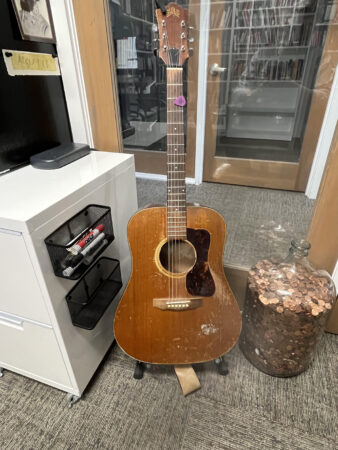
While in the Navy, I wrote a few songs here and there, but the big musical leap forward that happened is that I bought the guitar I still have—it’s a Guild, a real pal, and has been with me for 53 years now.
Another thing almost happened, and I am frankly glad it didn’t. I was stationed in Norfolk on a fast attack submarine from 1973 to 1975, and while there (I really don’t recall how this came about) I auditioned, just me and the guitar, for a gent named Moose at Pat Robertson’s studios there. They had a record label, I think. His response was something like “Huh. I’d like to hear you again, but with a band this time.” But as it happened, we were headed off to sea again, and so that never came about. If only . . . if only . . . like Lady Catherine de Bourgh, I am sure I would have been a great proficient.
When I got out of the Navy in 1975, on the way back to Idaho I met a man from our Christian community in Moscow named Dave Tong, and we started discussing the idea of forming a band when back in Moscow. We met Dave while our family was on the road back to Idaho because he was working in one of our national parks as a ranger for the summer. He had gotten that job because his last name was Tong, and they thought from the application that he was a minority, but he actually had a Welsh background or something.
So we started a band, and it was called Morning Star. I played rhythm guitar, Dave played lead guitar, Bart Baranco played second lead, and Jack Riggs played bass. I don’t remember what we did for percussion. Jack went on to become a medical doctor, and then after that, the lieutenant governor of Idaho. I think that this band went until 1977 or so, and then people started graduating and stuff.
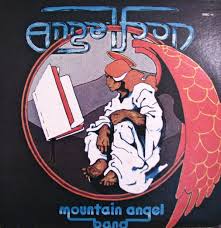
In any case, it was time for another band, this one being called Mountain Angel Band. Dave Tong and I were still in, and my brother Evan, just out of the Navy, jumped in, and Tom Garfield, a friend of ours from high school, also just out of the Navy, was our drummer. Three guitarists and a drummer, and the three guitarists took turns playing bass. We made our one and only record in the fall of 1978, and the band continued playing for local events until 1982 or thereabouts.
It will appear for a moment that I am drifting off the topic of music, but such is not the case. I completed my MA in philosophy in 1979, but I still had a little bit of money left available on my GI Bill. I was pastoring our church by this point and it had several hundred people in it, which meant I couldn’t really get away for seminary, but our idea was to get away for the summer for just a smidge of seminary. So in the summer of 1979 we went up to Vancouver, BC so I could take some courses at Regent Seminary. The courses were mostly fantastic—a class on the book of Acts by John Stott, on the cross by Leon Morris, and a class on economics by a gent named Brian Griffiths, who later served as a chief policy advisor to Margaret Thatcher. The one class that was kind of a dud was the one on hermeneutics, in which we were working through the book of Galatians together. I don’t recall the gentleman’s name who taught us, thankfully, but when we got to Hagar and Sarah, the women who were “two covenants,” he said, “Yeah, well, Paul shouldn’t have said that.” But here is the kicker, and the tie-in to music. While we were up there in Vancouver, Nancy and I went into a little Christian bookshop, and I was going through their record bins. And what should I find there but a copy of our album. I turned to Nancy and said, “Look, honey. We are internationally unknown.” Nobody is buying it up here either.
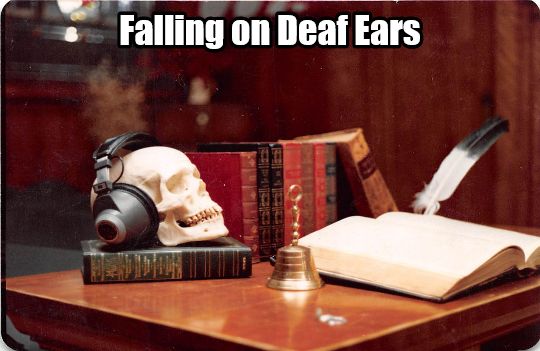
After Mountain Angel Band was no more, I was still interested in making music, and so after a bit I rented some studio time and recorded another album. This was a solo album, but with various friends roped in to sing back-up, or to do other musical stuff. The album was called Falling on Deaf Ears. This one was released on cassette tape, and had a homemade cover featuring a skull on a desk with a set of headphones on. The home-made aspect can be seen in the picture we staged, and the meme font.
Since those early days, my days have tended to fill up with other responsibilities. But ideas for musical projects still push forward and take center stage from time to time. I would say that they manifest themselves in five distinct ways. The first would be random ad hoc solo projects, under the aegis of something I call The Jenny Geddes Band. That would be me and whoever I round up. Jenny Geddes was that stalwart woman who threw her milk stool at the minister’s head at St. Giles Cathedral in 1637. The second would be doing video covers of earlier material, like the Hold Your Peace video, also with the aid of Jenny Geddes. The third would be the editorial work I did in getting the Cantus Christi into print, both the 2002 version and the 2020 version—to which I contributed metrical settings for some psalms, and some melodies as well. The fourth—surprise!—would be playing around with AI for help in making demo tapes. I don’t believe AI should be treated as legit when it comes to performances, but I believe it is superior to a sheet of music when a songwriter is pitching a song—great for demo tapes, in other words. The fifth area would be pulling out the guitar to practice for participation in a periodic community concert hosted by what has come to be called The Dads’ Band. And of course singing at church goes without saying, as I manfully try to learn the bass line for more songs than I currently know.
Show Outline with LinksA Sampler
Having said so much, allow me to trespass upon your patience a little bit further.
Here is a song from the Angelfood album, a song called Hear the Light. My girls use it as their bumper for their What Have You podcast.
Here is another one from that same album, called Amen Again.
This one, also from Angelfood, represents my first toe in the water with regard to psalm singing. The second verse veers off from the text, but hey. It was a start.
And on to the next album. This was from Falling On Deaf Ears, and is called Are You Looking for the City?
And here was a song that represents my views on evolution, a little piece called Science Fiction.
I may be overstaying my welcome here, but this is one more from Falling on Deaf Ears. It is called Peace Peace Peace.
As far as musical satisfaction goes, I am probably the happiest with this one. This was done years later, a Jenny Geddes version of a song I had written many years before.
Now for a couple that got into experimental waters. This first one is another Jenny Geddes round up of friends, and I don’t quite know what genre bucket to put this one in. It is about the abortion carnage and is called Got No Beds. We did this one shortly after the Daleiden videos came out.
Earlier I mentioned messing around with AI. Here is a demo tape for a song I wrote called Watch the Sun Down. The Jenny Geddes friend here was Darren Doane, the instrumentalist who “plays the prompts.”
Next up is a cover of Buffalo Springfield’s anthem, For What It’s Worth. And, for what it’s worth, this was the song that was actually played at my high school graduation. In the University of Michigan’s coliseum. Ah, brings back the old times, back when young people still knew everything, and were consequently speaking their minds. Okay, I guess that’s still going on. And those who used to be speaking their minds are now providing so much resistance from behind. Oh well.
And last, you can, if you like, but only if you want to, obtain, for the low price of one dollar, the songs I wrote that are on the Angelfood album. How’s that for a sentence? If you do purchase it, since it is only a dollar, I can’t imagine how a year from now you would ever think about it long enough even to regret the purchase.
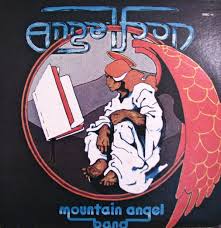
Angelfood
Here are three songs I wrote for the internationally unacclaimed album Angelfood. They are Hear the Light, Amen Again, and Psalm 121.