

Introduction
The biblical doctrine of the resurrection of the dead is straightforward. At the end of our fallen history, there will be a general resurrection of the dead, whether just or the unjust, and all will stand before Christ. He will divide the sheep from the goats, in the great winnowing judgment. The sole basis for that judgment will be the binary in Christ/not in Christ. In addition, in a separate judgment, He will evaluate the quality of each man’s work, with gradations of blessing among the sheep and degrees of torment among the goats.
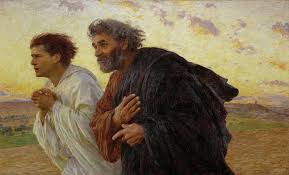
This great event at the end of fallen history is something we need to keep in mind at all times, living our lives in the light of it. But because it is so far down the road, God in His kindness has determined to provide us with a down-payment resurrection, a foretaste of that final day. This resurrection is one that was accomplished in the middle of human history. That was the resurrection of Jesus Christ, outside Jerusalem two thousand years ago, a sign to us all that He will in fact bring all the rest of the harvest into the barn.
The Very First One
Scripture tells us about this in multiple places. And if we want to understand the general resurrection, we need to look straight at the resurrection that God gave us to contemplate. If we want to know what will happen, we are invited to look at what has happened.
So let us begin with Paul’s appeal to King Agrippa.
“Having therefore obtained help of God, I continue unto this day, witnessing both to small and great, saying none other things than those which the prophets and Moses did say should come: That Christ should suffer, and that he should be the first that should rise from the dead, and should shew light unto the people, and to the Gentiles.”Acts 26:22–23 (KJV)
The resurrection of Christ was not a stand-alone resurrection. It was a harbinger resurrection. It was portent resurrection. A down payment resurrection. Notice that Paul places the resurrection of Jesus as the fulfillment of what Moses and the prophets were all talking about. They had all said that Christ would come, and they also said that Christ would be the first to rise from the dead. I need you to take special note of that phrase—”the first that should rise from the dead.”
The word for “first” here is protos, and it has two main meanings in Greek. One meaning is the first in a temporal sequence, and that is the meaning that has to be the definition here. For example, Acts is the second book Luke wrote, and Luke was the “first book” (Acts 1:1). In 2 Tim. 4:16, Paul refers to his “first defense.” That is, he is referring obviously to his first court appearance. And of course, Jesus Christ Himself is the “first and last” (Rev. 1:17).
The other meaning refers to preeminence, or rank, or authority. We can pick up on this meaning contextually. When Jesus refers to the one who wants “to be chief [first] among you” (Matt. 20:27), He is not talking about apostolic foot races. The disciples were preparing to throw elbows over who would have the highest rank. The first commandment is the greatest commandment (Matt. 22:38), and not the first commandment to have been given. When Paul describes himself as the chief of sinners (1 Tim. 1:15), he uses the word protos, and he is not saying that he was the first one to sin. He was not claiming to be Adam. He was claiming to have been preeminent in his insolence.
Now let’s come back to Paul’s statement to Agrippa. He said that Christ would be the first to rise from the dead. This cannot mean preeminent among the raised dead. In order to mean something like that, the reading would have to be “first among the risen dead.” That would indicate that out of all of those risen, the Lord held the most prominent place. So it cannot mean that because it does not say that. It has to be referring to the first in a temporal sequence. Out of all the people who are going to be raised from the grave (that is to say, all of us), Jesus Christ was the very first one. In the same way that Adam was the first man, with all others following, so Christ is the firstborn from among the dead . . . with all the others following.
When we say that Neil Armstrong was the first man to set foot on the moon, we are making a temporal claim. A certain honor goes with that, certainly, but the basic meaning of protos is first in the line-up.
Others Must Follow
Now if Christ is the first one to rise from the dead, never to die again, this means that others must follow Him. We must remember that when Lazarus was raised up, this was a type of what was to come, but not the thing itself. Lazarus was actually resuscitated (John 11:43)—he was going to die again. The son of the widow of Nain was resuscitated (Luke 7:11-15)—he also was going to die again. But Christ was raised in a completely different way, and he was the first one who was raised in that way.
“Knowing that Christ being raised from the dead dieth no more; death hath no more dominion over him.”Romans 6:9 (KJV)
Now because He was the first one to be raised in that completely different way, this necessarily means that there will be others who follow Him, and it also means that their resurrection will be just like His. Not a resuscitation, like Lazarus, but a resurrection from the grave, like Jesus. So we also will be raised in that completely different way. This is what will happen on that Great Day when the graves will split open on the ground, and the sky will split open above.
The transformation that Christ went through at the moment of resurrection involved much more than a transition from dead to alive. It was certainly that much, but the momentous nature of this event is often overlooked. Christ was not just liberated into life from death. He was also transformed from a mortal life to an immortal one. In His incarnation, He took on a body that could die. He took on a mortal body. But in the moment of resurrection, He took on a body that could never die.
And this is what is going to happen to us.
“For our conversation is in heaven; from whence also we look for the Saviour, the Lord Jesus Christ: Who shall change our vile body, that it may be fashioned like unto his glorious body, according to the working whereby he is able even to subdue all things unto himself.”Philippians 3:20–21 (KJV)
Conclusion
Now what this means is that the idea that when we die, we simply “move house,” receiving a heavenly body somewhere else, has to be in error. If that is the case, then the resurrection of Jesus Christ from a grave in the ground is sui generis, absolutely unique. And if that event were absolutely unique, it wouldn’t make sense to call it “the first.” Yeah, it would be the first but it would also be the last.
The first sheaf of the harvest was brought before the Lord as the firstfruits (Lev. 23:10-11). This meant that the rest of the harvest, just like that first sheaf, was on its way. And so when Christ is described as that first sheaf in the resurrection, this necessitates a general resurrection—He is the “firstfruits of them that slept” (1 Cor. 15:20). The Lord’s resurrection and ours are simply earlier and later aspects of the same event. It is all one harvest. The firstfruits is the guarantor of the final harvest.
So we have the firstfruits of the resurrection located in history, two thousand years ago, giving us assurance that the rest of it will happen. And we are enabled to look at that resurrection with the appropriate kind of faith because we have been given “the firstfruits of the Spirit,” who helps us in our groaning, as we long for the “redemption of our body” (Rom. 8:23).
The Spirit who is at work in us, helping us to long for the general resurrection, is the same Spirit who raised up Jesus. And so we know that the thing is certain.