

Introduction
One of the intellectual problems that conservative Christians have is that they have allowed evolutionary assumptions to seep into their understanding of human history downstream from the question of our origins. They deny the theory of evolution proper, as well they ought, considering it to be, in the words of Malcolm Muggeridge, “one of the great jokes of history.” This is fine and good, as we all need a good laugh from time to time. But the discussions and debates about evolution all tend to center on the early chapters of Genesis, intelligent design, and arguments about how the Grand Canyon formed.
This is right and proper in its place, but at the same time we need to be careful to guard ourselves against evolutionary assumptions elsewhere. In our focus on “prehistoric” man, we sometimes forget that in the creationist account there is no such thing as prehistoric man. Adam was historic man, which has ramifications for our understanding of all subsequent history.
The evolutionary assumption I am referring to is the mental model of “savage to civilized.” But Adam and Eve were not savages. They were young, they were untested and immature, they were innocent . . . but they were brilliant. All such natural gifts were hobbled after the Fall, but not at all erased. And properly understood, this necessarily affects our reading of ancient history.
It makes all the difference in the world whether you see history as an account of man falling from a great height—the devolution of man—or as an account of him scaling a great height. If you take it as the latter, then you will tend to attribute the progress seen in the last millennium to the next stage of evolutionary progress—this is just “what happens”—instead of thanking God for the grace of the gospel.
Who’s in the Game?
If we take the scriptural account in a straightforward way—which it is clearly our duty to do—this means that we are going to receive as true certain realities that will cause the academic cool kids to dismiss us as mindless cornpones. Those conservative believers with doctorates are the cornpone intelligentsia. They will chortle and point at us. This should really not distress us very much because the people mocking us all think that men can get pregnant.
So once we start acknowledging the brilliance of ancient man, the cool kids will want to lump us in with various New Age moonbeams who, in their rejection of scientific materialism, have veered into esoteric accounts of UFOs, crystals, messages from beyond, not to mention other hooey from the Orient. The Christian account is utterly different from all that, but we do have to tip our hats to the New Agers in at least one respect. The brilliance of ancient man is a stone cold fact. It is a hard fact, just sitting out in the open. Christians and New Agers account for it in different ways, but at least they know it is necessary to give an account. In the meantime, the materialist Darwinian refuses to countenance any inconvenient data that wants to get underfoot.
It is like that assignment in elementary school where you are given a list of vocabulary words and are told to write a story with them. The Christian and New Ager take the same words and then write completely different stories. The evolutionary modernist ignores the assignment entirely, along with the words, and launches off into his own Spaceman Spiff daydream.
So yeah, I don’t find the arcane New Age accounts plausible or likely at all. But their accounts are far more plausible than the idea that our hominoid ancestors climbed down out of the trees in order to get on with the task of preparing themselves for the arduous task of building the Great Pyramid.
Basic Assumptions
For the sake of convenience, I am going to be using round numbers here.
Between Adam and Noah’s Flood were about 1600 years. That time period was spanned over the course of ten generations. The antediluvians were extremely long-lived, living eight or nine centuries, and they all spoke one language. These long lives meant that the transmission of knowledge and wisdom over generations was not going to be as great a difficulty as it is today. Noah’s father was Lamech, who was 56 years old when Adam died, so there is no reason Lamech could not have told Noah about his conversations with Adam. Methuselah, Noah’s grandfather, was 243 when Adam died, and Methuselah did not die until the year of the Flood, when Noah was 600. Same thing there.
The global climate prior to the Flood appears to have been sub-tropical and mild. Fecundity had to have been the order of the day. Cain, the third human being on the planet, was able to go off and build a city. Given the life spans, and all these conditions taken together, there is no reason to think that the global population was tiny at time of the Flood. If each woman had 20 children—not outlandish if she had 200 years of fertility—the world’s population by the time of the Flood could have been in the neighborhood of 20 billion—over twice the world’s population today.
[NB: 10 children per woman would result in a much smaller population, somewhere around 25 million. I have added the tag Retractions to this post because over the years in various conversations I have given a much higher number than I ought to have for the “10 children per woman” calculation, billions instead of millions. I still think it was billions but the math was wrong.]
Technology and Man Hours
The reason population matters is that technology is a function of available man hours, and not primarily a function of native intelligence or training. If we dropped hundreds of highly educated engineers off on a desert island, they would have to use all their time building bamboo huts and getting the coconuts open. Once things stabilized and settled down, they could tell tales to their children and grandchildren about smart phones and airplanes and superhighways and skyscrapers and the Internet. Among these engineers we might have men and women who actually know how to build all those things and who used to work on them before they were abandoned to our thought experiment. And that wouldn’t matter.
The reason they couldn’t reproduce a high tech society on that island is that they wouldn’t have the available man hours. They wouldn’t be able to make a pencil—for that they would. need copper mines, and a factory making yellow paint, and loggers, and rubber plantations for the erasers, or factories for the synthetic rubber, and a source for the mixture of graphite and clay so the thing could actually write. And then they would need to come up with the paper. All of this requires a large population that can provide the man hours for sourcing, manufacturing, and distribution.
In his notebooks, Leonardo da Vinci sketched out ideas for any number of things that could not be built (or powered) during his lifetime, but he nevertheless had the ideas for them. You know, things like helicopters, parachutes, airplanes, self-propelled carts, diving suits, cranes, machine guns, ball bearings, etc. There was no shortage of genius there, but there was a shortage of man hours. The man hours would be necessary to gain the wealth to pay for it, develop the manufacturing capacity to make it, and finding the power to make it go. That power might be technological, or it could be slaves hauling huge blocks into insane positions. But nevertheless, the blocks are all still right there, and if you follow my argument closely you will see that they had to get there somehow.
So this is another strong reason for assuming large populations before the Flood, as well as immediately after, at the time of Babel. When we look at the accomplishments of ancient man, all over the globe, the things they did could not have been accomplished with tiny numbers. And if you are a young earth creationist, as I am, these remarkable feats, all over the globe, had to have been accomplished in a relatively compressed period of time. And that means a ton of babies.
But one of the tendencies of modern scholarship is to say that the ancients used to greatly inflate their numbers, which certainly may have been the case in certain instances. But no one who believes in biblical infallibility can appeal to such an explanation when it comes to various biblical accounts.
In 2 Chronicles 13, we are told that King Abijah of Judah came with 400,000 men to fight against King Jeroboam of Israel, who had 800,000 men. In the resultant battle, Judah was victorious, killing around 500,000 of Israel’s forces, which on any account would have to have been a massive battle—not exactly Stalingrad, but getting there. Then there was the time when King Asa had to face an army of a million Ethiopians, and their 300 chariots (2 Chron. 14:9). And when Moses led Israel out of Egypt in the Exodus, there were 600,000 men (Ex. 12:37). It is easy for modern scholarship to simply dismiss such numbers as hyperbole, but this is why we refer to unbelieving modern scholarship. Believers are supposed to, you know, believe. We should simply accept these numbers.
This is a different issue than the problem regarding the number of Solomon’s horses and chariots. In one place (1 Kings 4:26), there is a reference to 40,000 stalls of horses, and in another place we are told the number was 4,000 (2 Chron. 9:25). That is a challenge for exegesis, textual criticism, and harmonization. The problem is the discrepancy, not the mere fact of a large number. The Kings number in Hebrew is likely a scribal error, with the Greek LXX of Kings and the Chronicles passage preserving the actual number.
The thing to remember is that the megalithic structures that we can all go look at today would have required massive populations in order to source, pay for, and assemble. The same thing is true regarding other impressive feats. If you don’t have large numbers, then we are left struggling with the coconuts.
Accounting for Everything
What I am talking about is the need to account for everything we have right in front of us. When we undertake to give that accounting, we need to make sure to include ourselves in it. We are part of the show.
A number of years ago, Christopher Hitchens and I appeared on a show that Joy Behar had at the time, and there were one or two others on the set as well. They got onto the fact that the Bible has talking animals in it—you know, the serpent in the garden, and Balaam’s donkey—and there are these fundamentalists out there who believe the Bible, ho ho ho. Talking animals, ha ha ha. All of this, I am afraid to say, was at my expense. My response was, “But we’re animals and we talk.” And it was as though all of them walked straight into a brick wall.
In all their chortling over the impossibility of talking animals, they forgot about the billions of talking animals.
I have written elsewhere about my belief that King Solomon was behind the settlement of Central America. Now if a learned scholar were to deign to give me the time of day on this question, he would just sniff and say that the consensus in the journals is that ancient man did not have the navigational ability to transit the Pacific. Such trans-oceanic travel was beyond their capacity, you rube. I do get it, but my reply would be simple. when Captain Cook, harbinger of civilized man, representing all those who did know how to do it, arrived at Hawaii, right out in the middle of said Pacific, what did he find there? Who was waving at him from the beach? You guessed right . . . people. My argument is fairly simple. Somebody knew how to do it.
And don’t forget Easter Island, which is also way the heck out there.
A Cluster of Marvels
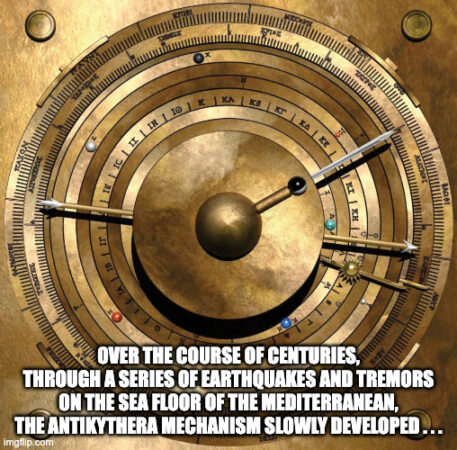
The meme above shows a cleaned up version of the Antikythera Mechanism. It dates from a century or two before Christ, and if you reflect on what it was designed to do, you will discover that all your flabbers are gasted. It is a hand-cranked mechanism with one input shaft. The mechanism contained over 30 gears that moved pointers on both the front and back of the mechanism. The dials showed the positions of the sun and moon in the zodiac, and which accounted for the moon’s variations in speed due to its elliptical orbit. It showed the positions of the five planets visible to the naked eye, and budgeted for their retrograde loops. There were numerous other functions geared to different calendars. And one of the smaller dials on the back tracked the four-year cycle of the Panhellenic games . . . just for kicks and giggles.
Then there is the small matter of megalithic architecture. All over the world, including cities that are now underwater, we have multiple examples of structures built with ginormous blocks. Not only so, but the blocks can be of irregular shapes and fitted together like they were pre-manufactured plastic Legos. There are the pyramids, of course, but such feats include A.D. latecomers in places like Machu Picchu in Peru. Stonehenge, built thousands of years before Christ, demonstrates true astronomical sophistication—and the large stones came from about fifteen miles away, the smaller stones from around 140 miles away, and the large altar stone came from northeast Scotland—430 miles. At least their transport crane didn’t have to worry about overpasses.
Don’t forget Easter Island, and all that business. Then there was the great civilization that the Amazon jungle has since swallowed up. The Minoans had flush toilets. What about the platform mounds of the Mississippian culture, or the complex societies in West Africa—with agriculture, metallurgy, stone walls and such. Who knows how many cities are buried under Saharan sand. The Great Pyramid, millennia after its construction, is just a few centimeters out of plumb. And—not that one would want actually to do this—if you disassembled that pyramid and set all the blocks end to end lengthwise, it would stretch from New York to Denver. That was quite the project.
The Long and Short of It
The manifest brilliance of ancient man is simply undeniable. On standard evolutionary assumptions, it appears as an inexplicable supernova. But it is like a supernova exploding without having been an ordinary star first.
On the creationist account, man was created to exercise dominion over the earth. He was created with the capacity to do so, and began wielding that capacity from the first. The tragic reality of sin made his labors much more difficult, and a lot more bloody, but his abilities were nevertheless undeniable.
I find any description of such men as over-achieving primates to be frankly unbelievable. And so as a corollary, I would urge Christians to disambiguate their belief in an historical Adam from the evolutionary residue that makes them think that after his exile from the garden of Eden, Adam spent the next 800 years hoeing a bean patch, retiring every evening to his grass hut. No . . . he had better things to do.